

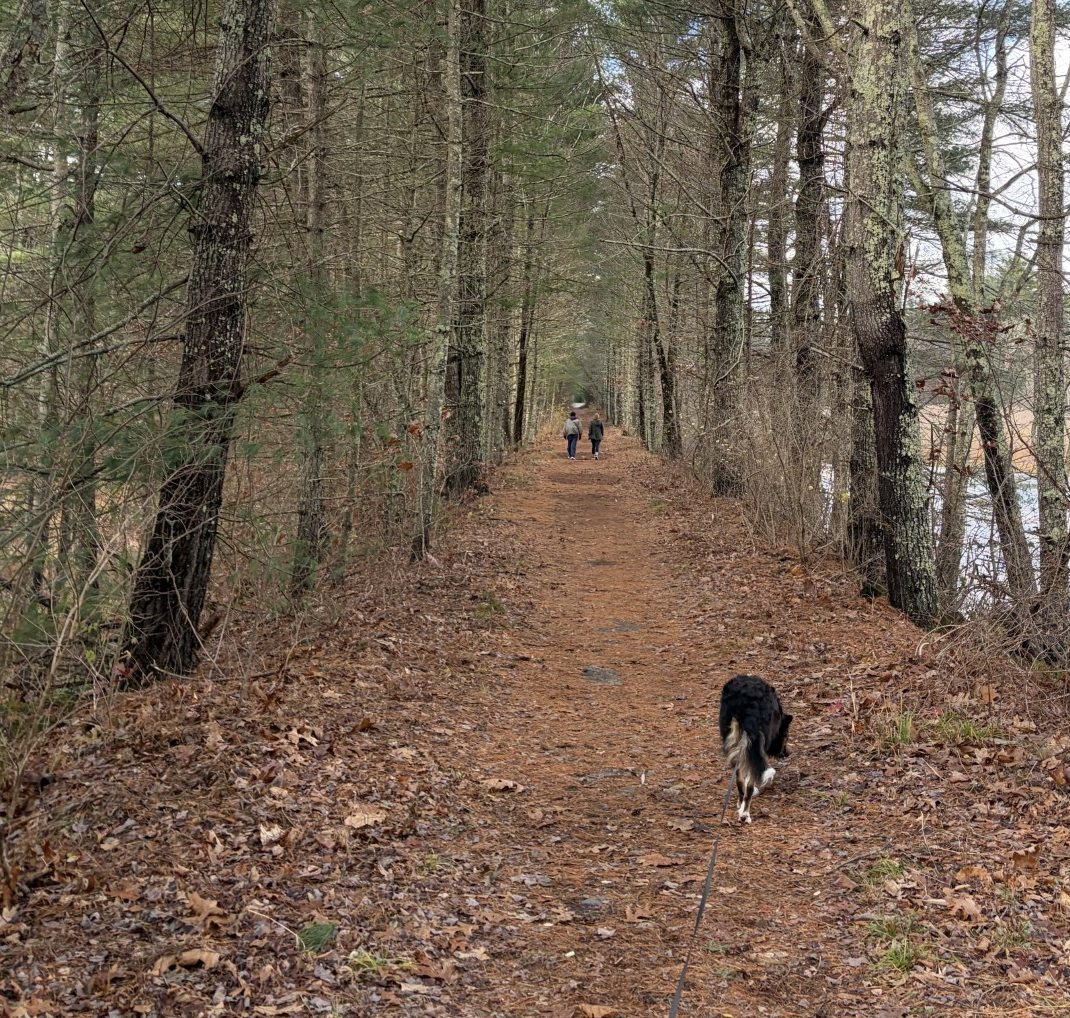
Not only is this part of the trail well-manicured, it has other people on it!
To study history means submitting yourself to chaos, but nevertheless retaining your faith in order and meaning.
-Herman Hesse
I was pretty sure that this next chunk of the Mass Central Rail Trail was going to be a fairly easy walk, with little to no bushwhacking. I couldn’t be sure, but the map and satellite views suggested it would be. Also, a couple of weeks ago, I met a guy, on a different part of the trail, who, if I understood him right, said it would be a nice walk. We parked across the road from where we ended up last time and headed out.
My reasoning was sound. The trail is broad, flat and straight. It’s buried under a carpet of dead maple, oak and birch leaves and the rails and ties are completely gone. Here and there, I get a glimpse of the ground under the leaves and it looks like it was paved in crushed stone at some point. The map says it’s “protected/unimproved,” but it doesn’t look to me that much will be required to improve it. We’re surrounded by a forest of new growth trees, none older that about 50 years. The railroad was finished and opened in 1887, so the original landscape must have been mainly farmland then. I can see a good half-mile or more in front of us – the path runs as straight as I-80 through Nebraska.
Waldo is up ahead, at his usual position, doing his Waldo thing. He needs no direction. Our course is obvious, even to a border collie who loves to search out different paths to take. I don’t know what he’s doing up there, but whatever it is, he’s happily doing it without feeling the need to involve me. We pass 4 other people with dogs, and one couple without, who are out for a walk on a cool autumn day, just like us. We also pass 2 bicycles, but Waldo doesn’t seem particularly bothered by them like he is on the Assebet River Rail Trail. I’m left with lots of time for my mind to wander as it is wont to do.
137 years ago, steam locomotives were belching, wheezing, rattling and screeching their way down this same route where we’re walking today. Trains in the US first started carrying passengers in 1830, but they were few until after the Civil War. Before then, since prehistoric times, man had three choices about how he could travel: on foot, on water in a raft or boat and using animal power to propel him and his goods in one way or another.
It was slow. Horse and oxen drawn wagons took from 3 to 6 months, in the 1850s, to go from the east coast to the west coast. This could take even longer if you had to make your own road, which was sometimes required. Walking would take about as long, but you didn’t need a road. Ocean-going sailing vessels could do around 7 mph, when the wind was blowing right, and it would require a trip around Cape Horn of 4 to 6 months, to go from New York to San Francisco.
You could go by boat on a river, but sailing was unreliable on rivers and steam boats weren’t available until 1810 (interestingly, Lewis and Clark’s adventure was 1804 to 1806). Rivers only flow one way, toward the sea, and even if you found one that was going where you wanted to go, it would really slow you down if you had to go upstream. It took Lewis and Clark 5 months to go 1,600 miles up the Missouri River from St. Louis to the Mandan villages (near present day Bismark, North Dakota).
Any way you did it was arduous and it took a very, very long time to go any distance.
And then, after the Civil War, railroads sprung up everywhere. After the driving of the golden spike at Promontory Point, Utah, quite suddenly, people were able to travel at speed! Sort of. Trains only traveled, at best, 22 miles per hour, but they could do it 24/7. The coast-to-coast travel time was reduced to 8 – 10 days. There was a lot of money to be made by building a railroad and connecting any place that had goods or people who needed to be moved “fast” and after the Civil War, railroads sprung up everywhere. The Pennsylvania Railroad was the largest corporation in the world, around the turn of the 19th to the 20th centuries, and was worth over a billion dollars. Trains were a big deal.
And here Waldo and I are, trekking down the fossilized bones of what used to be, not all that long ago, a wonder of human creativity. Trains were something that had a major impact on human society and served to reshape it into something totally different from what it was before and into something that could never have been imagined when the tracks were first laid down. And it all happened so quickly. Alas, most railways have now disappeared, rapidly becoming only faint memories and weed-choked bumps in the landscape, after the advent of the automobile and paved highways. In places like this, there is only a dusty suggestion of the magic that once was. There’s a lot of intriguing history passing under my boots.
By the time I’ve finished ruminating about all this, we’ve gone some 3.9 miles. I estimated the distance was going to be about 4 miles, but our planned trek turned out to be more like 3.5 miles. Because I wasn’t paying close attention, we ended up doing almost 4 miles anyway. We turn around and head back to the car and home.
There’s only about 6 more miles to do before we’ve walked what’s left of the entire Mass Central Railroad, 104 miles, from downtown Boston to Northampton, MA.
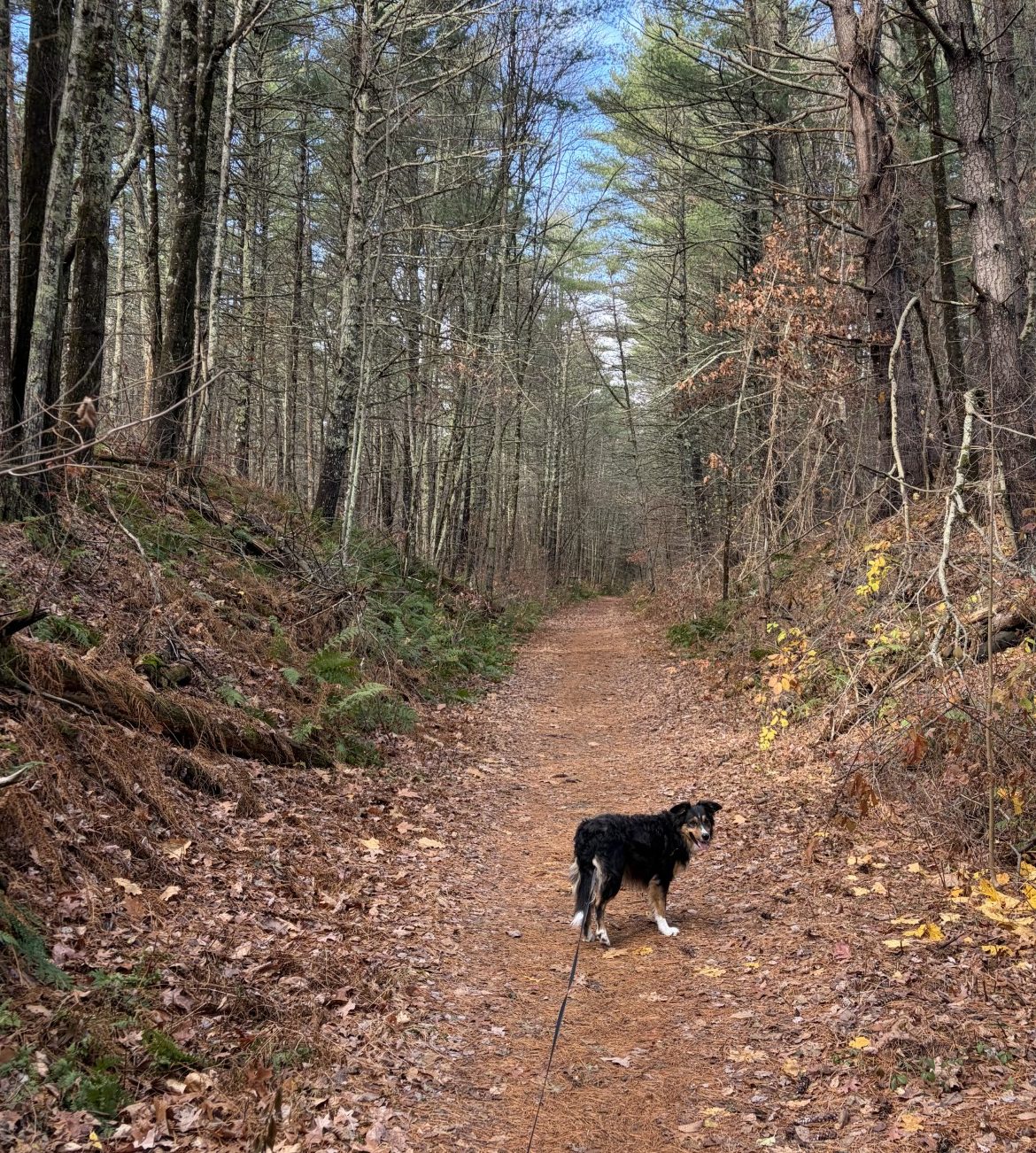
Straight and smooth!