
Walking with Waldo

August 16, 2022

The trail, next to a bisse, meandering through the forest.


In every walk with nature, one receives far more than he seeks.

-John Muir


This morning, I awake, dress and meet Bill and Ted in La Brioche, a boulangerie (bakery) across the street from my studio.  It’s small and cozy and has a welcoming and gentil (kindly) atmosphere.  The French (and this part of Switzerland) believe in l’art de vivre, or the art of living.  They choose to skillfully craft their experiences, including those of eating and drinking.  It is no wonder that the origin of the word gourmand is French.  The result is very tasty food and excellent beverages, including, of course, the local wine.  I don’t usually drink wine at home, but here, I relish it.  At La Brioche, I have a cappuccino and a tarte au framboise (a raspberry tarte).  Man, it’s a good thing I’m only spending a week here.  If I spent much more, I’d go home weighing a ton.

Afterwards, we walk to the tourist office where we are scheduled to take a bus to Veysonnaz, a small village not far away.  At the tourist office, we meet up with Luda, a retired colleague of my brother’s.  She was born in the Ukraine, but now lives in Houston.  Both Luda and my brother are retired geophysicists who used to work in oil exploration and bought property in Haute Nendaz when that was possible (Americans can no longer buy property here, although they can keep it if they bought it before it became illegal).  She is energetic, very friendly and will make a good companion for this morning’s trek – a local hike through the mountains.

It’s a short ride to Veysonnaz and the bus leaves us close to the beginning of a well-manicured trail that follows les bisses.  Switzerland used to have a lot of two things, high mountains and glaciers.  They still have the former, but global warming has cut deeply into their supply of the latter.  There is still enough water, though, flowing down from the heights, to provide hydroelectric power and the life-giving fluid necessary to grow crops and animals.  They’ve built reservoirs up high and one of the ways they bring the water down to where it’s needed is through long troughs, about three or four feet wide and three or four feet deep, made up of stone, cement, and other materials.  These troughs they call bisses and they run nearly horizontally, traversing the steep slopes of the Alps laterally.  Along the way, sluice gates can be opened to allow the water to flow down to where it is needed.  Because the bisses are nearly horizontal, the water flows vigorously, though not overly rapidly.

Trails exist alongside the bisses to maintain them and a volunteer community has arisen to keep them in good order for those, like us, who enjoy walking on them.  We are walking opposite to the flow of water, so we must be going uphill, but the grade is so gentle, it’s hardly noticeable.  Even for us old(er) folks.  The bisses and the trails wind around the steep slopes through dense forest and, in places, flatter open pastureland.  Just like New England, many of the trees are white pine.  Unlike home, there are very large trees, probably over a hundred years old, and remind me of the Black Forest in Germany and Grimm’s Fairy Tales.  The temperature is in the eighties, but it is much cooler in the shade of all these trees.  Add to that the friendly people we pass (most of whom speak English) and the beautiful vistas out over the Rhone Valley and you get a very pleasant hike.  If only Waldo could be with us.  And look at all those sticks!

Along the way we talk about all manner of things, including the Ukraine war, of course.  But we don’t spend too much time on that topic, Luda still has family there and I think she finds it difficult to think about it.  She’s been on this hike before and points out landmarks along the way, like the small village of Verrey, just a few yards uphill from our path, and tells us that it has only been the past ten years or so that they’ve had electricity.  I could do that.  I have done that for short periods of time.

Our hike takes us to Planchouet, another alpine village, about seven and a half miles from Veysonnaz.  There, we have a nice late lunch.  I have a croûte de fromage avec jambon et oignons (cheese on toast with ham and onions) and a local beer.  Délicieux!

After lunch, we catch another bus and go back to Haute Nendaz.  The trail continues on and ends up right outside my front door, but it is a couple of miles further and I’m feeling a little tired and my back is starting to hurt.  My mucus membranes are a little raw too, but I decide that’s because I must be coming down with a cold.  At any rate, we get back home and, after eating a wonderful dinner of grilled rabbit, prepared by Ted, I go off to bed, feeling like I’ve earned the right to sleep this night.

I get texts that tell me that Waldo is doing okay, but, damn, if only Waldo were here,  sharing this day!


Watch where you’re going, Ted! You’re on a cliff face!

Posted by Byron Brumbaugh in Walking with Waldo, 0 comments

Kids playing in the water fountain on a warm day in Martigny.


The animal kingdom is destined by nature to serve, and that service is fulfilled in alleviating the temporal and physical needs of man…

-Saint Bernard


The next morning, I awake with the sun just peeking over the serrated mountain ridge across the valley.  It shines over the middle of my balcony, through the large window and glass door, directly onto my bed and in my eyes.  Misty clouds hang around the jagged peaks and the early morning light glints off the meandering Rhone River as it winds its way through Sion.  The air is still and cool, enticing me to go for a hike along the steep, but walkable, slopes.  Birds sing tunes unfamiliar to me and the smell of dewy grass, white pine and green shrubbery tickles at my nose.  What a glorious morning greeting in the midst of the Alps!  If Waldo were here, we would be out roaming around, looking for sticks.  (I want to check on him, but it’s too early.  There’s a six-hour time difference between here and Massachusetts, so I’ll have to wait until at least 2 PM).  It’s so early, and I am still tired from my journey, so I decide to go back to sleep for a bit.  I pull the curtains to get the light out of my eyes and I’m soon, once again, unconscious.

Reawakening at about 9 AM, I walk up the hill to Chez Michele.  My luggage indeed showed up last night, but not until around 1:30 AM.  After a cup of coffee and a croissant, Bill, Michele (his wife), Ted, William and I take the bus to Sion and catch the train to Martigny, a village at the mouth of the Rhone Valley.  The plan is to visit the Saint Bernard Museum there, and maybe, pet the puppies.  In the past, Martigny was a starting point for pilgrims to cross over the Alps to get to Italy.  Some 20,000 people a year hiked over a high pass, two-thirds of them in the winter.  Needless to say, many trekkers got into significant trouble and some monks founded a hospice near the summit to care for them.  Dogs were bred, the Saint Bernard, to help them rescue the travelers when they were in need.  It’s a myth that they carried kegs of wine or brandy around their necks, but sometimes they did carry milk from cowsheds.  One dog, named Barry, saved over forty people during his lifetime and is still a remembered hero in the area.

The museum is housed in a building on the edge of town.  They still breed and raise the dogs whose ancestors saved so many.  Unfortunately, since Covid, they don’t let visitors pet the puppies any longer, but you can still see them lolling about in the shade, trying to get out of the heat.  The temperature is about eighty degrees or so, but with all that fur, it must be hard to stay cool.   The museum also has artifacts and pictures of what the trek was like when the pilgrimage was still popular.  Now, of course, there are trains, roads and tunnels that pass through the Alps to Italy.

Also in the town are Roman ruins, including a bath and a small colosseum.  Martigny housed a Roman settlement (Octodurum) from the first century BCE until the fifth century CE.  What’s left are structures that are recognizable, although a mere shadow of what they once were, and stabilized so one can wander through them safely.  I walk through the entrance to the colosseum and, once in the middle of the arena, have the strongest urge to shout, “Where are the lions?  Bring ‘em on!”, but there is no audience to appreciate it, so I demur.

The town of Martigny itself has quiet cobblestone streets and a twelfth century church.  There are open plazas sporting artful water fountains that kids play in and many a nice café.  I had a cappuccino and then go searching for some local brandy.  We visit a distillery outlet, but all they have is apricot brandy, Abricotine (fruit brandy they call eau de vie or water of life).  The stuff is good, for sure, but I’ve already tried some and I’m looking for something different to bring home.  In addition to the ubiquitous grape, apricots can be found everywhere in the valley.  Abricotine is a local specialty.

Our tour done, we returned to the train, and then the bus, and got back to Haute Nendaz at about 8 PM.  Not at all a late hour for French dinner, but I am hungry.  We go out to a local restaurant where I enjoy a fine meal and a glass of Gamay vin rouge.  A long day, lots of walking and interesting things to experience.  A quick text tells me Waldo is doing fine and I’m off to bed.

Waldo would have loved all the walking and meeting all the people, for sure.


Brother Bill in front to a 12th century church.

Posted by Byron Brumbaugh in Walking with Waldo, 0 comments

August 2, 2022

The Alps, in the distance, Sion and the Rhone Valley, as seen from the bus, winding its way up to Haute Nendaz.


Roads were made for journeys, not destinations.

-Confucius


And so, I’m now in Switzerland.  Switzerland is a land-locked country in the midst of high mountain peaks – the Alps.  It is bordered by France in the west, Germany in the north, Austria and Lichtenstein in the east and Italy in the south.  It has four official languages, German, French, Italian and Romansh.  The raison d’être for its existence comes with a long and varied history and prehistory.  There is evidence of people living in the area for centuries before the Romans invaded.  The local tribes, celts, were known by the Romans as the Helvetii, a name that persists into today (Swiss money is referred to as CHF – Confoederatio Helvetica Franc) and the Romans occupied the area for a time.  The mountains and valleys of Switzerland saw military conflict with the French, Germans, Italians and the Holy Roman Empire.

In 1291 an alliance of cantons was formed against the Hapsburg dynasty.  Allegiances flowed back and forth and finally, in 1815, at the Conference of Vienna, the European powers agreed to permanent neutrality for Switzerland – something that France, Italy, Austro-Hungary and Germany would benefit from.  They have remained neutral since.

In 1848, the modern state of Switzerland was founded.  Today, it has the second largest GDP per capita in the world.  Its major industries are banking and finance, chemicals and pharmaceuticals, mechanical/electrical engineering and metals.

As the train (electric) skirts around the north shore of Lake Geneva, and then up the Rhone River Valley to Sion, I see tall mountains on both sides – the Alps.  Some still have significant snow and ice on their peaks.  In the valley, the ground is tilled and, it seems to me, mostly covered by vineyards.  The Swiss do love their wine — as do I.  We pass villages made up of old (nineteenth century and older) traditional stone buildings, well cared for, that suggest a heritage-rich, quaint and calm ambiance.  Being neutral, Switzerland avoided the devastation of two world wars and its history is there to be seen everywhere.  Nowhere, even in Geneva, are there large glass and steel skyscrapers that haunt much of the rest of the twenty-first century world’s large cities.  It feels like I am transported into an ancient, simpler time, but with a few modern conveniences, like buses, cars, trains and planes, embedded for comfort.

We finally arrive in Sion, a small city on the Rhone River, population around 30,000, that spans the valley floor.  White glaciated peaks on each side of the valley rise to around 11,000 feet.  The city streets wind around in no obvious pattern.  There are cars and buses on the streets, but there is no evidence of traffic jams or too many cars.  Gas is a bit more than $8 a gallon, which I’m sure plays a role, but the Swiss also seem to try to keep things the way they have been.  The roads are bordered by pastel-colored buildings of four to five stories high; many are apartment buildings, mixed in amongst commercial buildings.  There’s a McDonald’s across the street from the train station (I find that embarrassing), although why anyone would choose their fare over the traditional Swiss offerings, I can’t guess.  The food and wine here are excellent, better than what we can get in the States, unless you want to pay the exorbitant cost of importation.  Not much of either is exported.

On arrival at the Sion train station, William and I go next door to the bus station.  Our bus doesn’t leave for 45 minutes, so we go to the Grand Café.  I order a café renverse (a cup of coffee with milk) and a small quiche, warmed.  I am quite pleased that my French is understood and I understand what the clerk behind the counter is saying.  All those hours of studying French are paying off!

The bus arrives and we are soon driving over a bridge crossing a very full, muddy Rhone River and then up the steep mountain on a serpentine path.  The city spreads out below us as we ascend and the entire Rhone Valley can be seen hemmed in by white topped Alpine peaks.  We climb higher and pass many older chalet-like buildings, some homes, some hotels and restaurants.  The road is narrow, barely wide enough for two cars to pass, with a sharp drop-off on the downhill side.

Our stop is the last one on this route and, after we get off the bus, we climb the hill to the Edelweiss After Ski Bar.  There, William and I meet my brother Bill and William’s father Ted.  After some beer and wine, we walk down to where I pick up keys for the studio apartment I’ve rented for the week, then we’re off to have dinner at Chez Michele, Bill’s chalet, about a half-mile up the hill.  Bill owns the house, but rents it out most of the year.  Haute Nendaz is a ski resort in the winter and there are many apartments to rent there.  We have a delicious dinner prepared by Ted, who is a wonderful chef, and then it’s off to bed.  It’s been almost 24 hours of travel time and I am spent.  I crawl under the duvet and drop off without worrying about my lost baggage.

I do wonder how Waldo is faring, though.


Rooftops of Haute Nendaz, nestled high up in the Alps.

Posted by Byron Brumbaugh in Walking with Waldo, 0 comments

July 26, 2022

The Alps, near Geneva.


Surely, of all the wonders of the world, the horizon is the greatest.

-Freya Stark


The day of my next adventure has finally arrived.  My plane leaves for Philadelphia this afternoon.  From Philly, I’ll be flying to London for a plane change, then on to Geneva.  From there, I go on a two-hour train ride to Sion, a city in the Rhone Valley.  Then it’s just a short 45-minute trip in a bus, switchbacking its way up a steep mountain slope, to Haute Nendaz, where I’ll be staying for a week.  The whole trip will take right around 24 hours.  First, though, I have to drop Waldo off with the woman who watches him when I’m away.

I throw my luggage, Waldo’s portable crate, food, bowls and treats into the car, put the dog in his seat (front passenger side) and we’re off.  I’m pretty sure Waldo knows something is up before very long because we almost never spend so much time in the car.  When we do, it’s either for a long walk, or I’m leaving him somewhere.  When we get to the house where he’ll be staying, he recognizes it, wags his tail and seems happy to greet his caretaker.   I set up his crate and leave.  As I close the door, I look back through the window and Waldo is staring up at me with the most forlorn face fur can make.  Big brown sad eyes look up at me as if to say, “What?  You’re leaving me?”  Then, after just a few seconds, his attention is diverted to something in the room and the moment is gone.  I’m sure he’ll have a good time.

I park my car in a commuter lot and take a bus to Logan Airport, getting there about four hours early.  I never know what to expect from security and try to give myself at least three hours for international flights.  I’m all packed and ready to go, it’s just a matter of waiting at the airport or at home, so it doesn’t bother me.  It’s Thursday and there aren’t that many people traveling, so security is a breeze.  I grab something to eat and drink and settle down in the stiff uncomfortable chairs and wait.  I brought plenty to keep myself busy, so it’s no big burden.  I wear a KN95 mask the entire time – most of the other people are not masked.

Traveling by twenty-first century passenger jet is magical.  As I step into the plane, I feel like I’m leaving the real world behind and entering a surreal and artificial metal and plastic tube.  The door closes and my fate is sealed – I am of the world, but no longer in the world.  There’s a lot of noise and vibration, the tube jostles about and the most amazing, spellbinding sights can be seen through the small windows.  The world is out there, thousands of feet below, dutifully rolling from in front to the rear.  After a period of time, the plane lands and I am again in the world, but at a distant place from where I started.  It’s like I walked into a teleportation device from Star Trek, but a breathtakingly slow one.

Through the years, I’ve traveled by means of all sorts of conveyances.  First generation passenger jets, prop planes of a wide variety, steam locomotive trains, diesel-engine drawn trains, freight trains, buses, on horseback, horse drawn wagons, boats of various kinds and sizes, bicycles and, of course, my own two feet, are all on the list.  They all are also relatively uncomfortable (at least the way I use them) with plenty of delays and opportunities for things to happen to interrupt my trip.  Today is no exception.  My flight to Philly arrived at Logan late.  At Philadelphia, I only have about twenty minutes to walk (there were no alterntives) a long way to get between my arrival and departure gates.  When I do get to my departure gate, no other passengers are in line to get on the plane.  The door is closed and sealed behind me as I walk down the aisle, looking for my seat.  I just barely made it.  Finding my place, I get settled and send off a hurried text to see if Waldo’s doing okay, before I have to put the phone in airplane mode.  It doesn’t take long for a response – he’s doing fine.  We take off on time and it’s not long before we’re out over the Atlantic in the dark of night.  We’re scheduled to arrive in London at about 8 AM.

At Heathrow Airport in London, I go through customs and walk directly to my departure gate.  No Covid tests or vaccination cards are required any longer (although I did bring my card) and my flight is boarding as I get to the gate.  From there, it’s a relatively short flight to Geneva and I enjoy a pleasant conversation with a retired couple from Bristol, England, who used to manage four pubs in the area around where they live.

Customs in Geneva was much like that in London, only a lot slower and more crowded.   I make it to baggage claim and find out that my checked baggage didn’t make the plane in Philadelphia.  Sigh.  I arrange for it to be brought to me in Haute Nendaz and I go to the train station, which is a short walk in the same building as the airport.  Still not many people are wearing masks…

At the train station, I meet up with my grandnephew, William, who flew in from Gatwick, England, just an hour or so before me.  I wasn’t expecting that, but am quite pleased that it happened.  We made connection by cellphone and were soon on the train to Sion.  I’m exhausted, but I think William is even more so.  He said he was only able to catnap now and then for the past seventy-two hours.  It wasn’t long and we’re both sound asleep sitting up.

I’ll bet Waldo slept much better.


The Rhone River Valley, as seen from the train.

Posted by Byron Brumbaugh in Walking with Waldo, 0 comments

July 19, 2022

I’m ready, let’s go!


The function of man is to live, not to exist.  I shall not waste my days trying to prolong them.  I shall use my time.

-Jack London’s Credo, published at the time of his death at the age of 40.


Waldo is having a hard time of it today; I can tell he’s a little uncomfortable.  The temperature when we started out this morning was at its lowest for the day, in the high-sixties, but it quickly rose to something in the mid-seventies — high enough that it’s hard for Waldo to keep cool.  He’s walking from shady patch to shady patch and then lying down.  His tongue is fully extended and flattened out and he doesn’t hold sticks for long so he can pant more effectively.  Waldo and I have been together long enough that I can sense when he’s uncomfortable and I usually can intuitively guess why.

I think life is lived mostly by making intuitive guesses.  I know that’s the way I do it.  I go from moment to moment, making decisions and taking courses of action and I don’t really know why.  Oh, I have ideas and theories, but at best, they’re just guesses based on past experience and intuition.  That can’t be helped because, even for the smartest of us, we just can’t know enough, if such knowledge is even possible, to live life rationally.  Everything is an educated guess.  But most of us do a pretty good job of it, just the same.  We make mistakes often, but we’re able to keep the ship upright, keep the wind in the sails and make some sort of progress in life.  And we learn from our mistakes.  There’s something to this subliminal ability to make good guesses.  Something that, whereas maybe not infallible, does serve at least as a good place to start.

When I first started flying an airplane, it was very much an intellectual activity.  I paid attention to how much aileron I was using, how hard I was pulling on the stick and pushing on the rudders.   I paid close attention to what the instrument dials were saying and adjusted what I was doing to the numbers I saw.  This kind of flying does not allow you to get ahead of the plane – that is, know what the plane is going to do before it does it.  You’re always behind, playing catch-up, trying to counteract what just happened instead of directing what’s about to happen.  The plane is doing the flying and you’re just going along for the ride.  But over time, and a lot of hours of practice, you get a “feel” for the plane and the plane eventually becomes an extension of your body.  There’s a rewiring of your brain that happens that allows you to fly instinctively.

At first, I would think, I want the plane to turn and go over there, so I’ll move the stick so much to make that happen.  Later on, I would think, I want the plane to do this and it would automatically just do it.  I wouldn’t have to think about it any more than I have to think about the mechanics of moving my arms and legs.  I want to walk down the rail-trail and all I do is set the intention, the rest just happens.  I want a plane to fly in a loop, and voila, I’m upside down.  I’m flying without cognitive awareness of the process.  I’m the one flying, the plane is just a suit of clothes that I put on before I left the ground.  That’s a very good thing because there is a lot that has to happen while flying that does require rational thinking and you need to put your attention there.  But there is much also that does not.  And that is where the wonder, the magic, the glory of flying is.

Just so, living life intuitively is the art of just letting it happen.  Living in the moment and enjoying the wonder of it all.  That doesn’t mean, though, that you shouldn’t think about what it is you should do.  Intuition is something that grows and improves over time, just like the ability to fly a plane, and it doesn’t always lead to making the right decision.  Even high-time pilots can screw up and unintentionally make an airplane crash.  But the real act of living is in the living, not thinking about living and thinking should be subordinate to living.  Think about what you’re doing, sure, but then do it, fully, completely and fully engaged.  Pay attention to what’s happening in the moment, because that is your life.  All that other stuff is just you thinking about your life.

Waldo is on his feet again and ready to go on down the trail.  I may be projecting myself onto him by saying this, but I don’t think I’m far off the mark when I say that he’s pushing himself to get to the car and then home to chill in the AC.  He’s not done walking, by any means.  But he could use a little break.

I know I can.


Gimme just a minute…

Posted by Byron Brumbaugh in Walking with Waldo, 0 comments

July 12, 2022

I’m comin’, Waldo, I’m comin’!


Be aware of wonder.  Live a balanced life – learn some and think some and draw and paint and sing and dance and work every day some.

-Robert Fulgham


Ah, late spring and early summer — there’s almost always a time of day when the temperatures are cool and the weather is dry.  I always look at the weather forecast the night before and take my best guess as to when to go for our walks, then check it again in the morning when we get up.  Not that it would stop Waldo and me from walking otherwise, but there’s no reason not to use the best of the day to advantage.  This morning, it’s around 7 AM when we start, the skies are clear and a soft fresh breeze keeps us cool as we make our way down the tarmac.  Waldo’s out front, pulling a bit on the leash, as if to say, “Come on!  Let’s go!  Let’s go!” and I’m in the rear, pulling the other way, saying, “I’m comin’!  I’m comin’!”

It occurs to me that this tug of war is a good metaphor for much that happens in life.  Newton’s third law, every action has an equal and opposite reaction, applies to a lot, not just an energetic dog walking his “master” down the trail.  There is a push and pull to everything.  If that were not so, then things would change precipitously, rapidly going from one state to another without the time to assimilate the differences.

For example, if a spring is stretched, there is a counterforce generated to return the spring to its original length.  Once the stretching force is released, the counterforce brings the spring back to the way it was.  There may be overshoot and the spring might become temporarily compressed.  In such a case, there is a force in the opposite direction generated to again return the spring to its relaxed length.  There would then be a back and forth until the energy generated by the first stretching of the spring is released through friction and then the spring will relax into its original condition – or nearly so.

There are many other examples like this in nature, some without oscillation.  If a pan is heated on the stove, then taken away from the burner, the heat drains away by radiation, conduction and convection until the pan is again at ambient room temperature.  If you get angry and the perceived cause of the anger is removed, the anger will dissipate and be replaced by something more calm until some other emotion comes to agitate you away from equanimity.  If you stub your toe, the pain can be excruciating, but it will eventually fade until the next trauma.  All things in life have a neutral point, a center, and forces that serve to bring things back to that point.  If this were not true, there could be no stability to life.

Just the same, these stresses, forces, heat, emotional upset and so on, change who we are to some extent and we never get back just quite to being the way we were.  Life’s experiences change us, even if in small steps and slowly.  This is that slow slog we all go through from birth to death.  If we were to track that neutral point as it changes on our journey through life, it would show a slow evolution from what we were to what we have become.  Each tug, each emotional strain, each pain or elation that we experience, bends that neutral point just a bit and drives it into a slightly new position.  This center of who we are, this essence of our existence, do we have any true idea of what it is?

I don’t think we can ever intellectually know that, but maybe, over time, we can get an intuitive sense of what we are and how we’ve changed.  Whatever we are, the best way to know about it is to let go of all the forces pulling us this way and that.  To forget about thinking and feeling and all the rest, at least once in a while.  Instead, just listen to the poetry of life, dance with the squirrels and sing with the birds.  That’s what comprises your life right now.

Waldo sees a tempting stick up ahead and gives the leash a jerk that shakes me from my reverie.  I have wandered off my center, the here and now, but now I once again feel the wind on my skin, hear the birds sing and the insects buzz, see the leaves doing princess waves in the trees and smell the perfume of the nearby flowers.

I can count on Waldo to snap me back to what’s important in life.


I’m right behind you!

Posted by Byron Brumbaugh in Walking with Waldo, 0 comments

July 5, 2022

C’est un vraiment bel endroit!


The ability to be in the present moment is a major component of mental wellness.

-Abraham Maslow


Waldo and I haven’t been off the rail-trail since fall.  Phyllis, although still walking nearly every day, got engaged and is tied up elsewhere and Christine’s interests have wandered off somewhere else too.  We’ve walked with both of them occasionally, but nothing with any regularity.  Waldo and I could venture off somewhere new on our own, I’m sure Waldo would love it, but the logistics would require that all trips be round trips because we only have one car.  That’s not a show stopper, but the truth is, without the good company, I’m not really that motivated to find a new path to trod.  Perhaps, in the next few weeks, we’ll go to the upper end of the Assabet River Rail Trail.  That would require an extra 40 minutes of drive time, though.

Our usual trail is familiar enough that I can walk it without thinking about it.  The good part of that is that I can concentrate on when and how to conjugate in the passé composé, the imparfait and the subjonctif without much effort.  Concentrating on French makes the time go quickly and being on a familiar path makes that easy.  I still take time out every so often to smell the roses, but less so than before the French.  I miss out on dancing with nature and listening to her poetry for much of the walk.

That seems to be a regular riff in my life.  I have a definite proclivity to think about stuff.  I can focus so tightly on ideas and logic that I’m almost oblivious to the rest of the world.  I’m drawn to concepts and ideas and enticed into playing with them and watching how they interact with each other.  Often that’s quite meaningfully productive, in all kinds of ways.  But it does detract from experiencing what’s happening right in front of me.  I’ve never mastered the ability, if that’s even possible, to solve a differential equation in relativistic astrophysics while retaining the awareness of my surroundings.  It’s like I’m transported to another time and place, other than where my body is.  That’s not a bad thing, as long as it’s done with a sense of balance.

While I was working, 99% of my time was spent in that other place – thinking about driving, thinking about how to medically care for a patient, thinking about the physics of flying, thinking about all kinds of stuff.  Then, in the other 1%, I would take a respite to just go out and be with nature, sometimes on a motorcycle, sometimes in an airplane, or a canoe, or on foot.  That now seems a bit backwards.  Rather than working and using a vacation to recharge one’s ability to work, wouldn’t it be better to be directly engaged with your life and the experience of what’s happening in the moment, to be tasting life, and using work to support that?  Live on the beach (or in the mountains, or in a forest, or whatever fits your fancy) as simply as possible and only go to work when you have to in order to be able to live on the beach, rather than fill your life with work and go to the beach so you don’t go nuts spending so much time at work.  Modern society seems to have its priorities all twisted up.

Thinking about this makes me feel a little guilty at spending so much effort to learn French.  But that effort will allow me to have a more meaningful trip to Switzerland.  I’ll be able to interact more effectively with more people there and have a broader spectrum of experiences.  That’s always the hook that draws me into walking away from the here and now.  I somehow convince myself that by doing so, my life will be somehow enhanced, made better.  Then comes the driver that the more time you spend in that other place, the better your life will become.  That digs the hole that sucks me in and then covers me up.

I think the secret is all a matter of balance.  Use only what you need in order to truly engage with life and then do what’s necessary to provide that need.  Don’t get sucked into doing more than that.  In the case of my learning French, okay, do it.  But I’ll do it in a way that doesn’t eat up a majority of my time.  Reserve that for living in the real world.  The world of the here and now.  I may not have that much time left in my life to learn French, but I don’t need to be perfectly fluent in it to benefit from learning what I can.  And the rest of the time, I can be here, wherever and whenever that is.

Right now, that’s here on the rail trail, my attention absorbed by the burgeoning life around me.  French verbs be damned!  At the moment, I have more important things to do.

Like, of course, walking with Waldo.


Covid Garden is looking good!

Posted by Byron Brumbaugh in Walking with Waldo, 0 comments

June 28, 2021

The emerald tunnel.


One ought, every day at least, to hear a little song, read a good poem, see a fine picture, and, if it were possible, speak a few reasonable words.

-Johann Wolfgang von Geothe


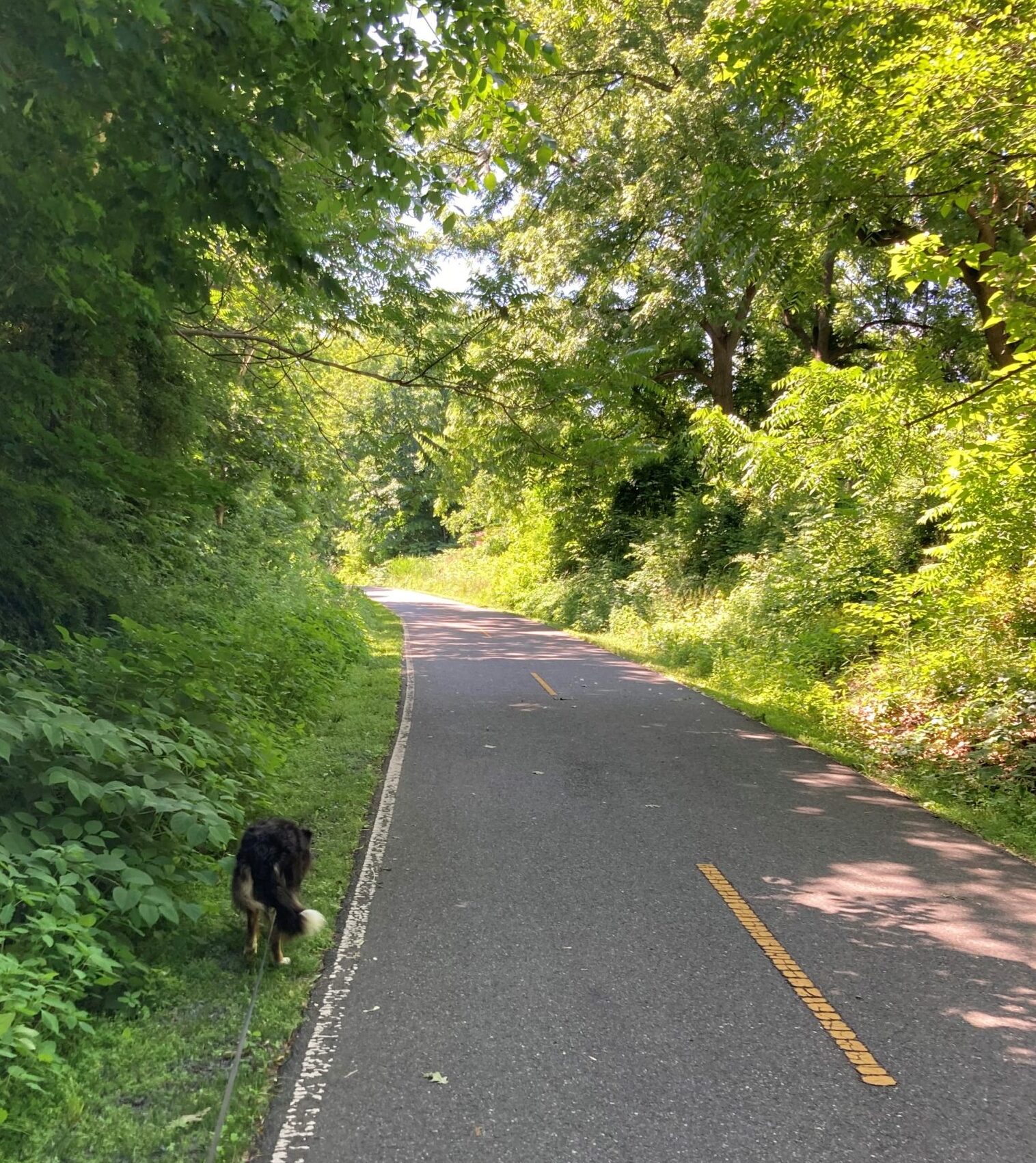
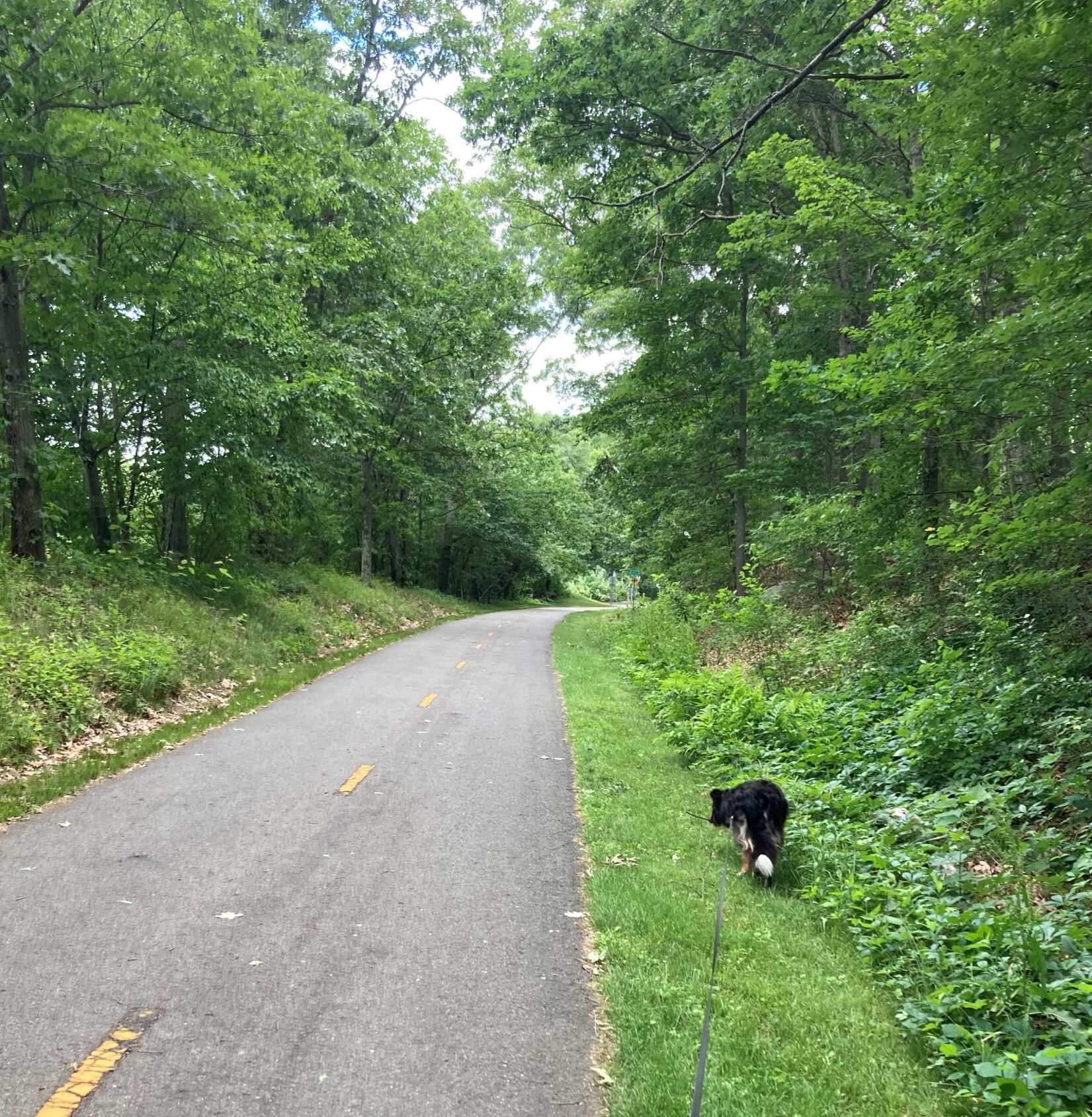
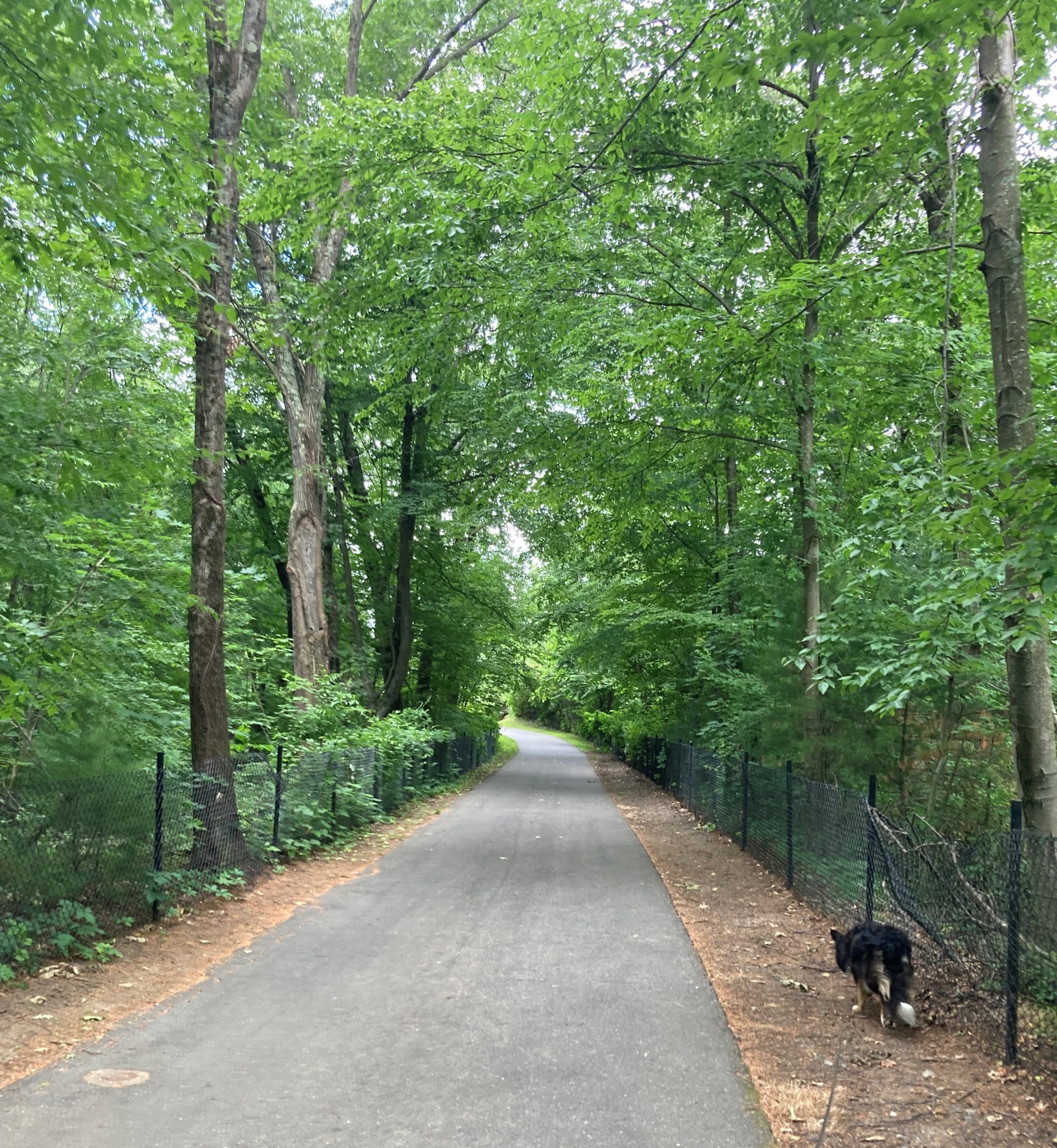
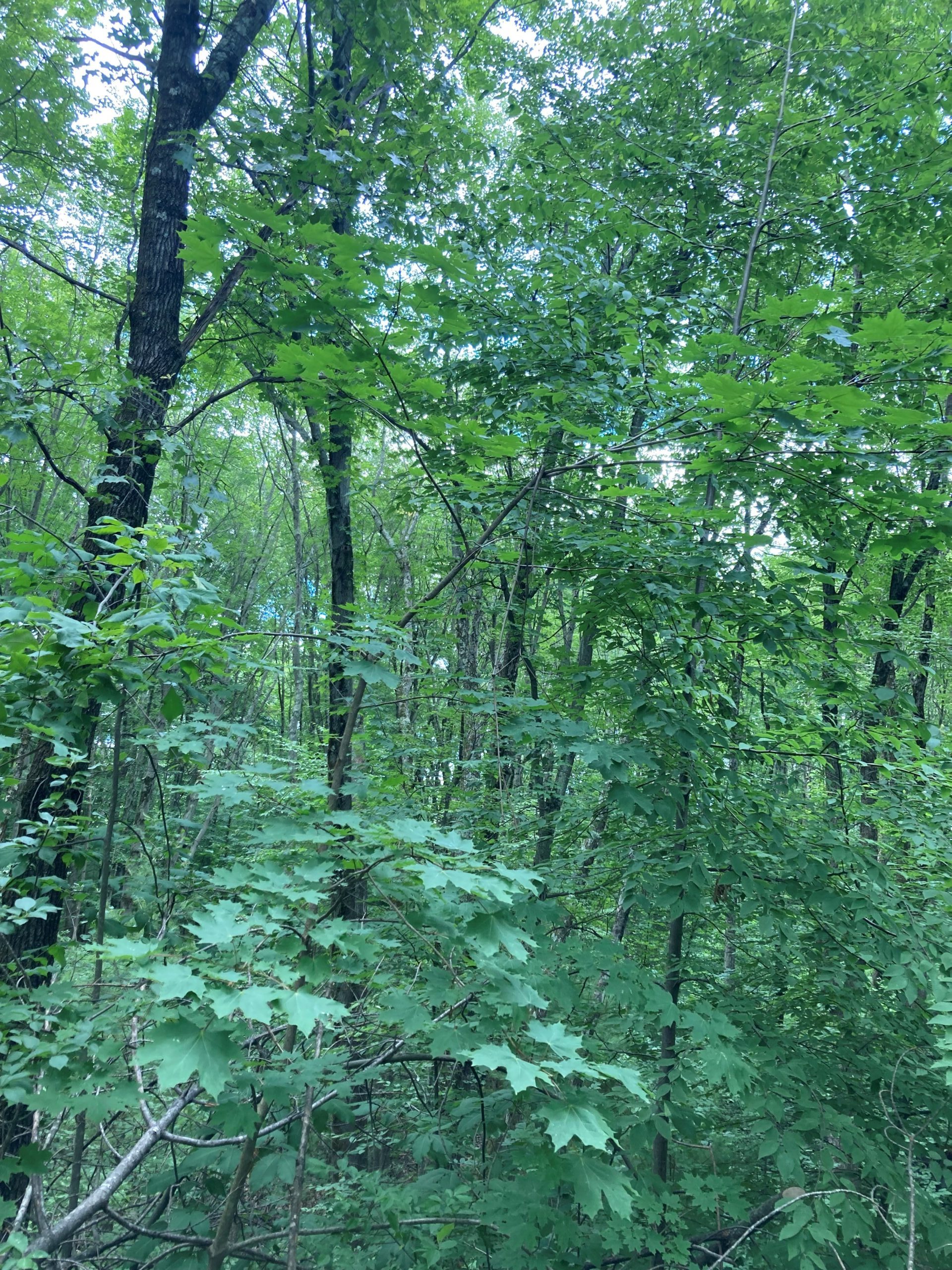
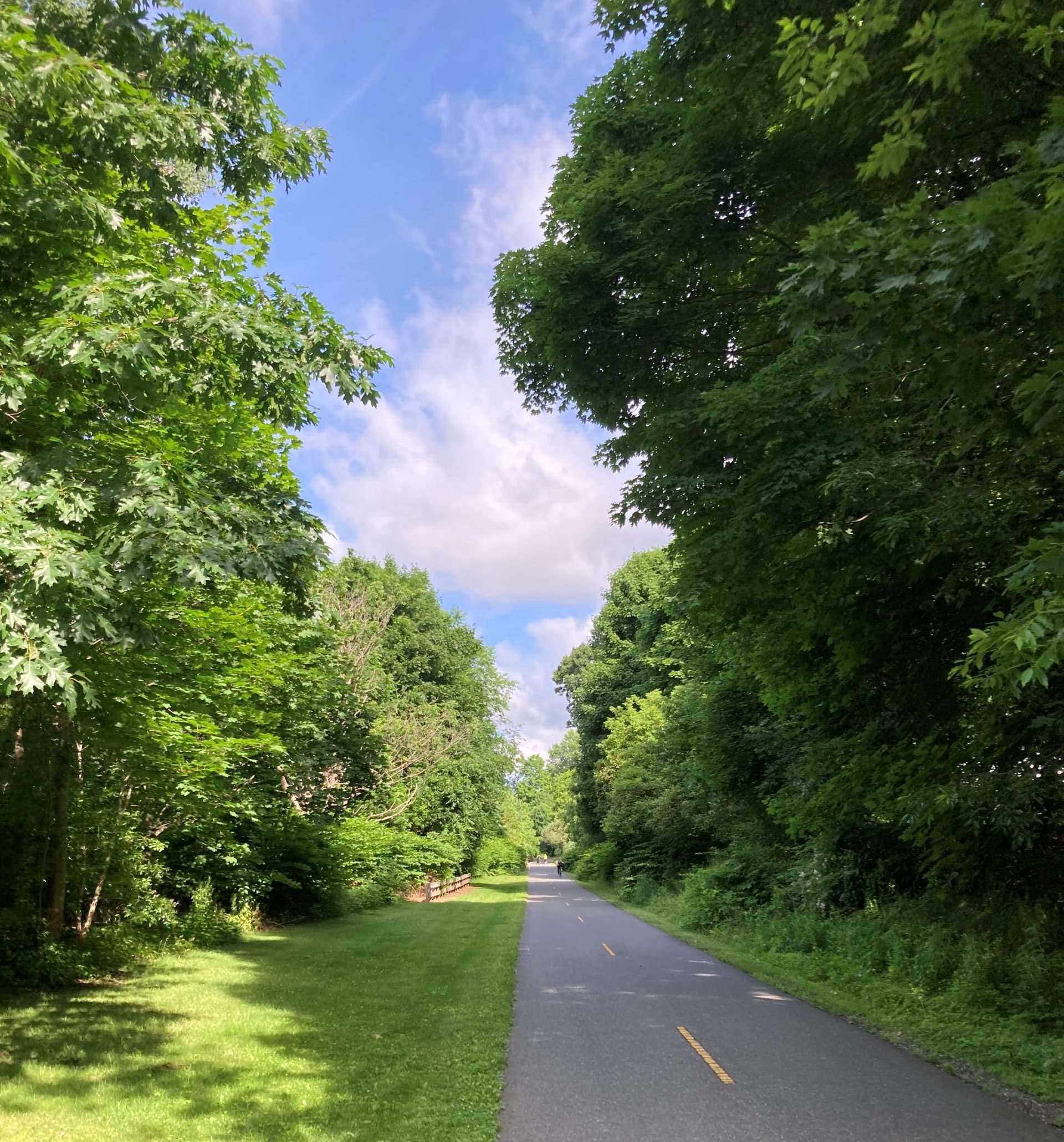
The rail-trail greets Waldo and I with a green smile this morning.  There are places where the tarmac winds its way down a tunnel running through of a vast ocean of leaves.  I feel like we’re walking through green pea soup — without the bacon bits.  The sky is clear, the sun is low, the air is still and the temperature is pleasant.  All life around us seems to be humming a happy tune – the birds are certainly singing celebratory songs.  Waldo’s up ahead, lost in the moment, and I’m trying to learn French from my phone.

My plan is to go to the French-speaking part of Switzerland in two weeks.  The app I’m using on my phone is the closest I can get to immersion in the language and I think it’s working pretty well for that. I’m also using a textbook and a computer course that supply me with the grammar and structure, but the app is what is cementing the strange way (for me) to communicate in my 73-year old brain.  I’ve been doing it every day while we’re out walking, without fail, for the past four months.  I have no delusions that I’ll be anywhere near fluent when I get there, but I should be able to interact in the local tongue on a basic level.

One might well ask, why would I bother?  I’m retired, I have no career obligations and no goals set to motivate me, other than the desire to talk to people that I meet in their native language.  Isn’t retirement the time to sit back, chill and enjoy what life one has left without the stress of striving for whatever life has to offer?  I don’t think so.

I remember, when I was in college, studying about the sunnum bonum.  That’s Latin for the greatest good.  Philosophers, for thousands of years, have argued about this.  Some ideas tossed around were, the greatest amount of pleasure for the least amount of pain, or to gain the most wealth and power possible, or to achieve the highest glory and praise, or to be the most respected adult in the room.  Some have suggested contentment and bliss, or to surround oneself with the love of others, or to learn how to love everyone around you.  Others propose that it is the pursuit of the greatest amount of good for the greatest number.  Maybe it’s something else, or maybe it doesn’t even exist – perhaps it’s simply the invention of a confused mind.  Another way to pose the question is, since we are all driven by something, does that something drive us in a good direction or bad?

Now that I’m old[er], I can’t help but wonder:  Did I lead a good life?  Is there something I have yet to do to complete my life’s journey?  Something that, if I don’t do it, I will die without achieving what I should have?  It all boils down to the question: What is the meaning of life?  Is there any meaning to it at all?  We’re born, we live a certain number of years and then we die.  What happened before and what happens after that is completely unknown.  It’s hidden behind an impenetrable veil.  And what happens in between is often obscured by a dense fog of confusion, misapprehension and self-scripted lies.  Maybe these questions are all vacuous and we are nothing more than the predetermined action of a purely mechanical universe that is merely evolving according to a set of inviolable physical laws.

But now, in my later years, I can’t help but wonder:  What should I do with the little time I have left?  That is certainly less ethereal and more to the point, isn’t it?  But then you have to ask yourself, what do you mean by “should” and we cycle back to all the other questions.  It’s no help, either, to try to reduce it to:  What do I want to do?  That just replaces the label “should” with the label “want.”  Still, I only have a relatively small number of years left to live and I would like to know the optimal way of spending the time I have left on this Earth.

When I think about this stuff, I keep coming back to the fact that I came into this universe at a specific time and place and I’ve been going someplace and somewhen else ever since.   I may not know where that place is, or even understand if it’s a good place to go.  But I’m moving.   There is a directedness to this journey, but I have no way of knowing if it is a good direction.  No matter what I choose, it will certainly end in the same predetermined event, my death.  Even so, I can’t help but wonder if I can’t accumulate something more on my exit than I had on my entry.  Maybe good or bad isn’t the way to order what happens in the in-between.  Maybe the best that can be done is to simply experience as much as possible of what the human condition has to offer and that alone answers the question:  What is life all about?  Give an extensional definition rather that an intentional one.  (An extensional definition gives meaning to a term by specifying its extension – that is, specifying every object that falls under the definition of the term in question. An intentional definition gives meaning to a term by specifying the necessary and sufficient conditions when the term applies.)  Maybe the good life is just that life that has tasted the widest variety of what the human condition has to offer.  Then when I ask:  What is a human life? I can respond with: The sum total of what I have experienced is the closest I will ever get to an answer.  Then the greatest good may be to get out there and experience as much of life as is possible.

At any rate, something like that seems to be what is motivating me to go to Switzerland armed with a thin veneer of French.  We’ll see what happens.

Meanwhile, Waldo is out sniffing, looking and listening, chasing after rabbits and carrying sticks, doing a similar thing.  He’s learning the language of nature and exploring the limits of his doggy existence.

And he suffers not at all by not going to Switzerland.

With or without French.


The world is so green.

Posted by Byron Brumbaugh in Walking with Waldo, 0 comments

June 21, 2022

Waldo! Get out of the bushes! There’re ticks in there!


Forever – is composed of Nows.

-Emily Dickinson


Today, Waldo and I have a markedly different walk, compared to yesterday.  We got up late, around 10 AM and it’s in the low 60s as we hit the trail.  94℉ one day and 61℉ the next — that’s quite a difference.  These temperatures are measured outside of direct sunlight and reflect the temperature of the air.  The reason for this is that sunlight passes directly through the air without being absorbed, we can see through it after all, but our solid measuring instruments do absorb sunlight and, if they are in direct sunlight, will get hotter than the surrounding air.  The measurements would not be correct unless we put the devices in shade.

Our bodies are like that too.  That’s why shade feels cool.  As I walk down the trail, I’m quite cool in the shade, but as I pass into direct sunlight, I get hot enough to start sweating.  It’s an odd sensation.  The temperature difference is very noticeable, even Waldo feels it, despite the fact that his skin is protected from the sun by his sable birthday suit.   He purposefully searches out and takes advantage of shade as it presents itself.

I like to pay attention to what is happening to me in the moment, as you can tell from reading these blogs.  It’s a way of drawing my attention away from the thoughts, ideas, and stories I perpetually tell myself.  Stories that really don’t make my life any better – they’re more perseverations, worries and plain entertainment than the solving of any problem.  It’s just a constant narration that goes on and I listen to it as if it were important.  But it’s not.  It’s like a dog seeing a squirrel.  My thoughts flow through my head and my attention is carried away as if nothing else was more valuable.  I’m no longer in the land of trees, birds, flowers, Mother Earth, the trail underfoot, or the vistas of green life in all its abundance.  I’m in the land of self-created abstraction.

But then I force myself back to reality by asking, What kind of tree is that?  Are all the trees leafed out, or are there some holdouts, waiting for warmer temperatures?  How many different bird-calls can I distinguish?  Can I see the birds that are making them?  What does that blossom smell like?  How many of the plants I see have blossoms?  The object is not to find answers to those questions, but to just ask them.  The asking is what makes me pay attention to the greater world outside of myself.  The next step is to pointedly refuse to answer them, which would draw me back inside my head, and to just soak in the experience of the moment. Alas, it’s something I have to do with a purpose.  I like asking questions, then trying to answer them.  It’s entertaining, you know.  But the real meat of the human experience is to just experience.  To smell the flowers, hear the birds, see the trees, experience how it all makes me feel, without conceptualizing about them.  We only live in the moment, you know.  Everything else is a self-created fantasy in the mind.

I look at Waldo.  He’s doing his Waldo thing, bouncing down the trail with a precious stick between his jaws, checking things out and exploring what’s there.  I have no doubt that he has a language center in his brain; after all, he can understand what I say to him.  But I highly doubt that he fills his mind with words, the way I do.  It would be my guess that his waking moments are filled by a flowing river of sensations and, although he can change the course of that flow, he doesn’t translate it into ideas that are a mere shadow of reality.  He lives in the now, as he pursues his constant search for the perfect stick.

Now that I’m retired, I have plenty of time to bathe my soul in the present.  But, alas, I don’t take advantage of it as much as I should.  I have a psychic momentum that tenaciously propels me down well-rutted tracks and takes me nowhere of any real importance.  I calculate, I philosophize, I reason, I formulate, I propose, I fret, I celebrate, all out of habit, and all to no great purpose.  The time I have left in life would be so much better spent in just drinking in the essence of the human condition, to live each moment to its fullest.  I’m retired now and I can finally get away with that without negative consequences to myself or anyone else.  Alas, it’s not that easy.

Waldo, if he’s not already there, could get there more easily than I.

But I keep trying.


Beautiful summer day. So much to enjoy!

Posted by Byron Brumbaugh in Walking with Waldo, 0 comments

June 14, 2022

Things are still in the early morning…


Spring being a tough act to follow, God created June.

-Al Bernstein


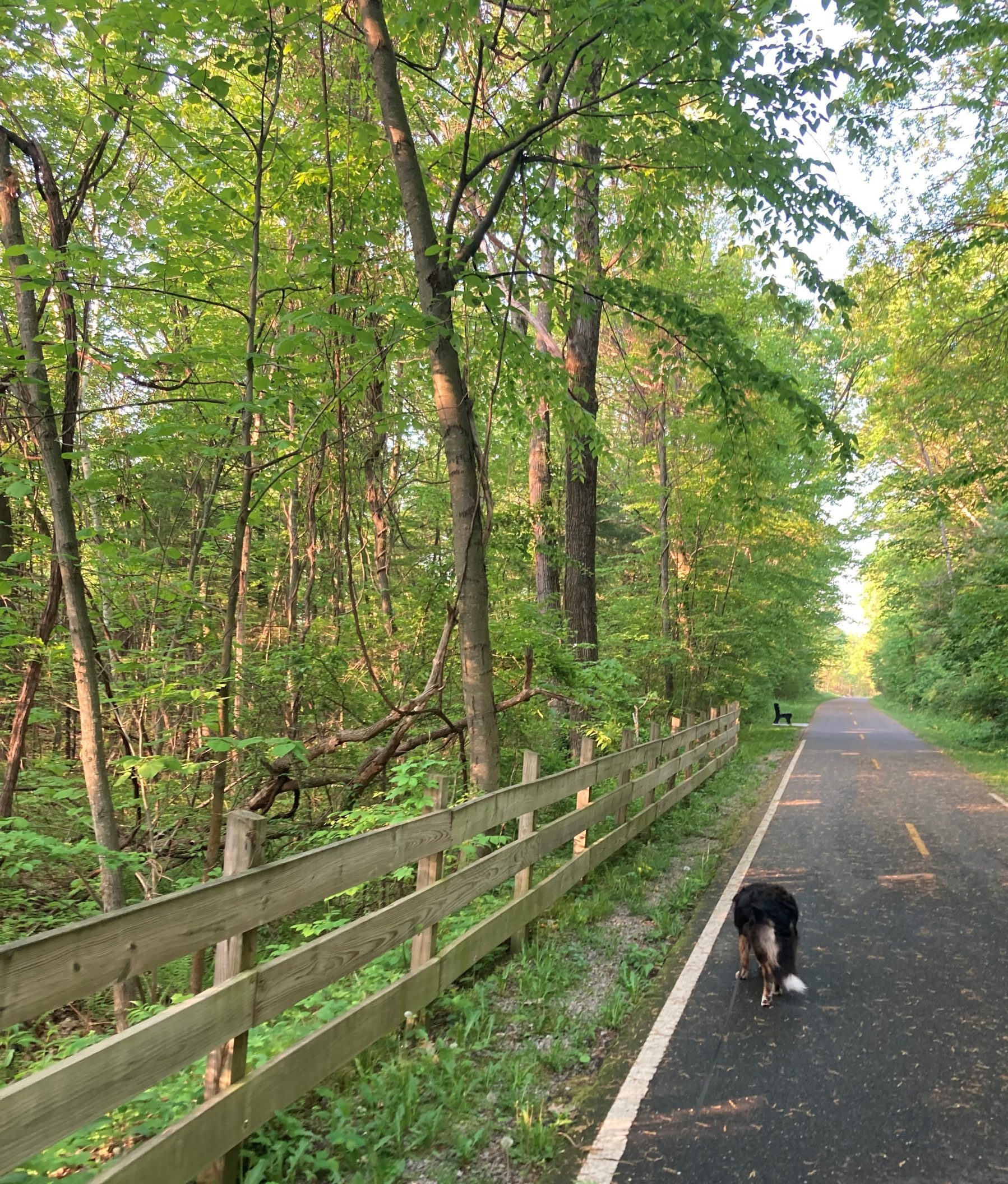
The forecast is for highs in the mid-nineties, so Waldo and I rise at 4:30 AM.  It’s still dark out as I crawl out of bed, but it morphs into predawn twilight as I get dressed.  Sunrise isn’t until 5:30, but it’s quite light out as we start our daily trek at 5 AM.  Once the sun is up, the shadows are long and the light has a golden hue that gives the landscape a magical, almost surreal, appearance.  I would not be surprised to see fairies flitting about in the weeds.

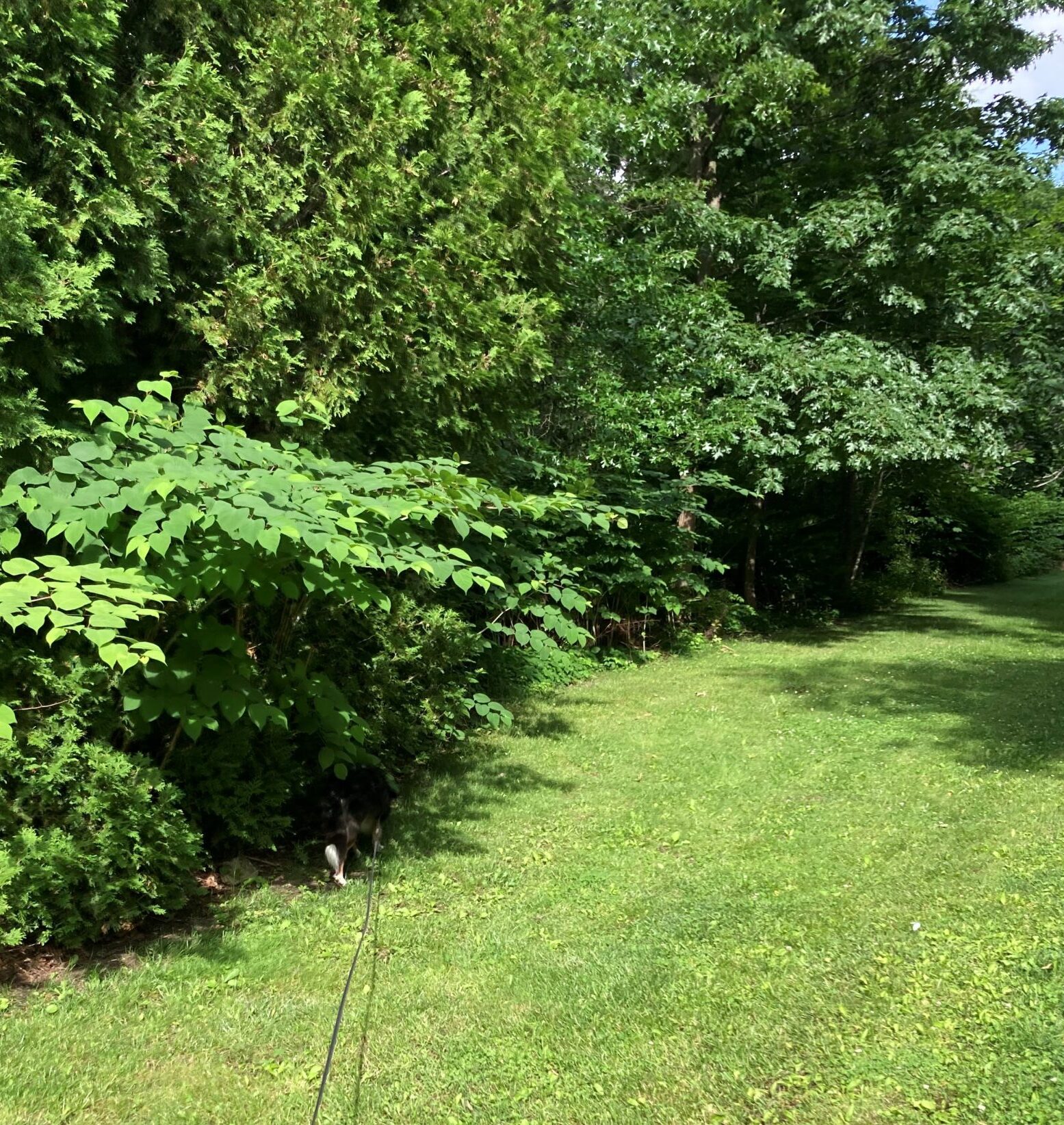
The temp is in the mid-sixties and a slight breeze blows over my exposed skin, giving the morning a cool, but not chilly, ambiance.  The trees, all now in full summer plumage, shimmy in the air and make shadows dance on the ground.  The Japanese knotweed now stands eight feet tall and dominates the land where it grows.  Common reeds too stand a couple of feet high in the drainage ditches alongside the trail.  Southern Indian azaleas, wild daffodil, ground ivy, lesser celandine and common blue violet are abloom with a riot of color.  Everything live has awakened and the summer solstice, marking the beginning of summer, is only a few weeks away.  With temperatures as high as they are in mid-May, I can’t help but feel high-summer is going to be a scorcher.

Having temperatures this high so early in the season does a number on Waldo.  He’s still sporting his heavy winter coat.  He’s shedding, but not yet that much.  I know, I know, most animals, including dogs, temperature regulate by panting.  Their furry coats actually help keep the direct sun off their skin and keeps it from warming the skin directly.  But, still, having a lighter coat must allow the air to circulate next to their skin and aid in cooling by conduction and convection, even if they can’t benefit from the evaporation of sweat.  Otherwise, why would they shed when it gets hot?  Waldo, this time of year spends more time looking for shade, as we trek along, than he does later in the year, in the same temperatures, when he has a thinner coat.  Also, he will turn and give me a “Water!   Water!” look earlier on.

The foliage seems to appreciate the higher temperatures.  The world is verdant and blooms are full and hearty.  In drier climes where I’ve been, things would have withered and browned.  But in New England, where we have plenty of humidity and rainfall, the sun provides better insolation, which means more food for photosynthesis, and doesn’t dry things out.  Out west, things would be all yellow and tan, wilting and drooping in the sweltering heat, but here even the grass, which is never artificially watered, stays lush and green.  I’m sweating, soaking my shirt with stale body odor.  On a hot day in the dry air out west, my clothes and skin wouldn’t get wet at all.  Instead, I would be growing a gritty, salty crust all over me, the sweat evaporating as fast as it’s formed.  Once home, I would feel like I’d taken a prolonged dip in the Great Salt Lake, instead of returning from a walk in the woods.

I remember living in Albany, New York, one summer.  It was so humid that you never felt like you didn’t need a shower.  All you had to do is leave the air-conditioned comfort of your home, cross the street, and your clothes were soaked.  It was so humid, I don’t think my sweat evaporated at all.  It just grew into pools and rivulets that ran off onto whatever was nearby.  Even writing was hard because the sweat would drip onto and emulsify the paper, making it impossible to move a pen around without tearing holes in it.  Of course, that was a while ago, before computers replaced pen and paper.

I don’t say all this in complaint.  It’s just another experience that life has to offer.  And it does provide me the opportunity for the exquisite pleasure of sudden relief as I step into my air-conditioned home.  It may be a bit wussy, but man, it feels good to sit down in my recliner and cool off in the AC with a cold drink in my hand.  Even Waldo appreciates the AC.  He’ll come in and flop over onto the bare floor, tongue extended, panting heavily.  Then, after an hour or so, he fully recovers and he’s back outside, romping around in the heat.

For a little while.


…and sometimes a little wet.

Posted by Byron Brumbaugh in Walking with Waldo, 0 comments