
Walking with Waldo

January 4, 2022

An unusually warm day in December, with fog.


Forget not that the earth delights to feel your bare feet and the winds long to play with your hair.

-Khalil Gibran


The other day, not long ago, Waldo and I were walking in the cold, but not too cold, December winter air.  It was still and foggy.  There was the slightest of breezes, evidenced by the mists moving at a slower-than-walking pace.  The sky was overcast and grey and the stark bony beauty of trees reached up into the clouds and bore witness to Mother Nature being asleep, waiting, waiting, ever waiting for warmer times.  The temperature was in the mid-forties and I was warmly swathed in my 750-fill parka with hood up and gloves on.  Waldo was dancing his way down the rail-trail, apparently oblivious to all except the sticks that lay before him amongst the dead leaves.

Then, within a span of only two or three steps, I felt the air warm by more than 10 degrees!  I walked into a bubble of hot air.  It was like I stepped into spring while still enveloped in winter.  Looking around me, I saw there was still lots of fog and no evidence of more than the slightest breath of wind.  Where did this warm air come from?  How did it get there without a forceful push to nudge the cold air aside?  After a few more steps, the cold returned, although maybe not as cold.  Walking on, the same thing happened again and yet again.  I’ve never experienced anything like it.  As we passed others on the trail, we all exchanged an amazed appreciation of this strange meteorological event.

I’m not a meteorologist (although I can spell it), but I did learn quite a bit when I was doing a lot of flying.  Pilots are at the mercy of the weather and, despite all the technology of the twenty-first century, it’s still something to be respected and sometimes avoided at all costs.  Pilots have to learn about meteorology in order to stay safe.  They have to know when it is the better part of valor to stay on the ground and wait for the improvement that will inevitably come.  You learn enough to be able to predict, to some degree, what conditions will be like a few hours in the future – at least on a probabilistic basis.

I know, for example, that the air is not directly heated by the sun.  The air is transparent to much of solar radiation – after all, we can see through it, if there are no mists.  The ground, on the other hand, absorbs much of it and gets warm because of the sunlight beating on its face.  As do we.  That’s why, on a clear sunny day, it feels nice and cool to get in some shade.  An air mass that lies on a piece of ground for a time, gets warmed, or cooled, by conduction with the ground beneath it.  It slowly assumes the temperature of the ground on which it sits.  When winds blow, the air mass moves to other ground, carrying along with it the temperature of the ground it left behind – for a time.  Eventually, convection will cause intermixing air masses to exchange energy that will equalize their temperatures.  But this takes time.

This equalization of temperatures of different air masses occurs at the place where they intermingle, called a front.  Warm air that moves into a mass of cold air is forced to rise above it (because, being warmer, it’s lighter) and their meeting place, on the ground, is called a warm front.  This movement causes a temperature inversion where the air at altitude has a higher temperature than that below it.  This prevents the cold air from rising and puts a lid on whatever is in the cold air, like fog.

What I experienced (Waldo didn’t seem to notice the difference) along with the other adventurous souls out for a walk in nature, apparently was a very slow moving warm front that was gentle enough to displace the cold air we started our walk in, without a breeze strong enough to cause convection that would intermix the airmasses.  If there is no mixing, then there can be a clear difference in temperature within a short distance.  What I find amazing, though, is that the temperature difference could be so great without creating a strong wind.

I have been accused, in the past, of destroying the enjoyment of the moment by intellectualizing the experience.  I heartily disagree. I believe that using our minds to peer into what we observe adds a whole different dimension to what is there before us, just like what happens when using any of our other senses.  Standing there, bathed in the moment, opening the pores of my soul, feeling Mother Nature do her thing with all six of my sense organs, my skin, my eyes, my nose, my ears, my tongue and my mind, deepens the appreciation of the magic and beauty that surrounds me.  I wouldn’t want to sacrifice any one of them.  What greater goal in life can there be than experiencing the human condition in as much breadth, depth and clarity as is possible?

And Mother Nature is truly wondrous, magical and beautiful.


Blanket of low-lying fog, just off the trail.

Posted by Byron Brumbaugh in Walking with Waldo, 0 comments

December 28, 2021

Come join us, there’s plenty of room!


The fires burn and the kettles sing, and earth sinks to rest until next spring.

-Clyde Watson


Winter is definitely here.  Temperatures are going down into the high twenties, the leaves are mostly gone and the first snowfall is not very far in the future.  I’m contentedly warm, in my parka and gloves, on the walks Waldo and I take and Waldo is very comfortable in his sable all-weather birthday suit.  Until covered by the all-pervasive white blanket of snow that’s soon to come, sticks are in abundance and Waldo happily moves them about, from one spot to another.

Nature has taken on a sleepy air of wait-until-spring.  Plants are hunkered down until a prolonged thaw, some months ahead, that will stimulate them to once again birth forth greenery and a proliferation of multicolored inflorescence.  The buzzing, flitting, often annoying business of insects is gone from the world and the absence of mosquitoes, gnats and ticks is not missed.  Many birds have left for warmer climes and the squirrels, rabbits and chipmunks are, for the most part, lying low in cozy hidey-holes.  If nature could, I think she would be absorbed, at these times, in the quiet reflection of things gone and what is yet to come.  It’s a time of quiet hiatus, a time to take a breath before the onslaught of rebirth.

I’ve lived in places near the equator, in Ethiopia, for example, where seasons didn’t have the dramatic change they do here.  In Asmara, in what is now Eritrea, at an elevation of around 8,000 feet or so, the year was marked by dry seasons, big rains and small rains.  I found it a little unsettling not to feel the rhythm of winter, spring, summer and fall, to mark time subconsciously by the throbbing pulse of the temperate zones.  I missed not so much the freezing snow and blistering heat (heat I could still get plenty of if I ventured off the plateau down to the coastal regions).  What I missed was the more dramatic ebb and flow of the world around me that marked time as I sailed through the course of the year.  The cooling days meant the social dance of school would soon start.  Leaves changing color and falling to the ground foretold the coming of Thanksgiving and then Christmas.  The first snow meant snowball fights, skiing, sledding and a warm cup of hot cocoa held between freezing fingers in front of a roaring fire.   Lengthening days and the slow greening of the world signaled that the slogging toil of schoolwork would soon be over and promised long days outdoors, free from the direction and supervision of adults.  In Ethiopia, I had to rely much more on a calendar than on an internal intuitive synchrony with nature.

Now, we are in the era of Covid.  The damned disease hasn’t changed the flow of the seasons, but it has overlaid it all with an ominous persistent pulsing of infectious surges that peak and fall without ever really going away.  The damn thing keeps morphing, evading our best attempts to get it under control, evolving into strains that can get around our immune systems’ ability to fight it off, or moving into areas that are not yet adequately vaccinated.  And the two strategies feed off each other.  Flourishing in a new area provides the opportunity to mutate into a form that makes it more infectious which then opens up areas where more people are susceptible to catching it.  It even has the ability to get around herd immunity so that if one survives their first exposure, they might not their next.  It is spring-time for the virus, and autumn for humanity.

Don’t get me wrong, I am not at all pessimistic about the future of our species.  Not because of Covid, at any rate.  We have the ability to get this under control, if not eradicate it, through science and experience.  The path through our plight will not be a straight one, however.  We are battling Mother Nature herself.  And She is powerful and She is resourceful.  It is an interesting time we are living through and only our descendants will be able to judge how well we manage it.  Until we do get Covid under control, we will have to be adaptive and mutate our behavior with mask-wearing, social distancing, revaccination, economic disruption, and anything else we can think of to help us ride the waves of the pandemic.  Just what we need to do will change with the circumstances of the moment as Covid evolves, much like what we wear changes with the weather.  However, our Covid autumn will become winter and then a bright new spring.  But until then, curl up with a good book and warm yourself with the fire of compassion that is born in each of us.  Take care of yourself and each other.

And you could come join Waldo and me on the rail-trail.

That, at least for now, is still safe.


There are all kinds of amazing things to see.

Posted by Byron Brumbaugh in Walking with Waldo, 0 comments

December 21, 2021

One structure, two “buildings.”


Outside of a dog, a book is a man’s best friend.  Inside of a dog, it’s too dark to read.

-Groucho Marx


For the past three years, Waldo and I have lived in a 492-unit apartment complex on a 40-acre plot of landscaped land.  There are 22 different structures housing those units, nineteen having two separate “buildings” and three with just one each.  The structures with two “buildings” are a single edifice and the “buildings” each have their own keys for entry, with no way to get to the other “building” without going outside.  Each “building” has its own number for a total of forty-seven “buildings.”  Each “building” has 12 apartments — some are studios, some with one bedroom and some with two bedrooms.

The structures are scattered over the 40 acres on a gentle slope of manicured lawn with islands of trees, bushes and flowering plants.  There are large, old blue spruce, common sassafras, red and white oak, Norway and red maple, flowering dogwood and other trees distributed about the grounds.  There are also thickets of northern white cedar, creeping juniper, hinoki cypress, Canada yew and other bushes growing in piles of red wood chips.  The flowers include rose of sharon, Catawba rhododendron and others I haven’t yet identified.  There are also several large granite boulders of various colors strewn about, no doubt left over from the original construction.  These boulders, the trees, bushes and flowers are spread throughout the grounds in such a way that Waldo and I can enjoy their variety while we wander around the grounds on the half-mile loop we use for our poop and pee excursions.  The grounds are well-kept and a real pleasure to walk in.

The road into the complex is shaped like a lollipop, with the stem divided into an inlet and an outlet drive, separated by an island of trees, bushes and flowers.  The stem meets a circle inside of which are four of the apartment structures.  Waldo and I live on the third floor of one of those that house two “buildings” on the far side of the circle.  It is a one-bedroom apartment, which is plenty for our meager needs, and has a small balcony from which Waldo can scan his realm and watch for interesting things to pass by.

One might suppose that a third-floor apartment would not be the optimum place to have a dog, especially a border collie who requires a lot of activity.  For the first few weeks of his life here, I had to carry puppy-Waldo up and down the stairs because he was afraid of them.  I am very conscious of the limitations of living where we do and I still take him out for walks every couple of hours, so he can get outside and romp for a bit.  But in some ways, it has proven to be more ideal than if we were to have a backyard that Waldo could run around in at will.  Because Waldo needs to be taken downstairs in order to relieve himself, I have to be attuned to what he is doing, much more than I would if he could go outside any time he wants.  I can’t get absorbed in the TV, my writing, reading or anything else and ignore him.  He can’t simply ignore me and go about doing his Waldo thing without asking for my assistance.  Waldo does entertain himself quite well without my help, but he still needs me to take him downstairs every couple of hours or so.  This means we are bound to interact with one another on a regular basis throughout the day.  Our interaction is not continuous, but it is pervasive.  We may not be thinking about each other constantly, but the other is always there in the background of our attention.

I can’t think of a single time when Waldo has come up to me and asked to go out that I’ve ignored him or regretted that I have to do it.  Sometimes I’m in the middle of something and I tell him to wait, which he dutifully does by lying down on the floor and staring at me until I make a move to get up.  When he clearly has to go out, and right now! he lets me know and I drop whatever I’m doing and I oblige.  I don’t complain about it, I don’t get upset that I have to do it, I just do it – in the rain, in the snow, in the freezing cold and in the sweltering heat.  And once I’m out there with Waldo, I truly enjoy it.  Waldo and I have become good friends.  We have synchronized our lives and fallen into a symbiosis that makes us both happy.

If there is one thing that I do think is missing, it is that Waldo has no place where he can run around at will off leash.  There are no convenient, nearby dog parks.  Instead, I put him on a fifty-two-foot leash and take him to a nearby park and let him run wild on the soccer fields.  Add to this the fact that a five-and-a-half mile long paved trail is only one mile away from where we sleep, a trail that is swathed in a natural beauty of wide variety, and I know we’re doing alright.  Waldo gets his exercise, and forces me to get mine, in a garden of sorts, both manicured and wild, that bathes us in beauty.

It is a good home for us.


Where we live.

Posted by Byron Brumbaugh in Walking with Waldo, 0 comments

December 14, 2021

The Assebet River Rail-Trail map, from Marlborough to Acton.


And into the forest I go to lose my mind and find my soul.

-John Muir


It occurs to me that, although I’ve written a lot about it, I’ve never described the Assebet River Rail Trail in its entirety.  It is Waldo’s and my favorite walk through nature, and it runs from Acton to Marlborough.  It follows, more or less, the railroad bed of the Marlborough Branch of the Fitchburg Railroad, about a fourteen-mile trek in toto.  Its northern terminus is next to the South Acton MBTA train station, a place where the train to Boston still runs.  The Southern-most end is in Marlborough, across the street from where Waldo and I park our car when we go for our walks.  In the middle there is a gap where you have to take to the city streets if you want to walk the full distance – something we have never done.  The southern portion of the trail is five-and-a-quarter-miles long and the northern section runs for three and a half miles.  The gap, of about five-and-a-quarter miles, is supposed to be developed at some point in the future, but at this time, one is forced to take a wandering route along the sides of roads with traffic.  Waldo and I usually stay on the first three miles of the southern portion, although we have walked the full five-and-quarter miles and also the three-and-a-half miles of the northern part.

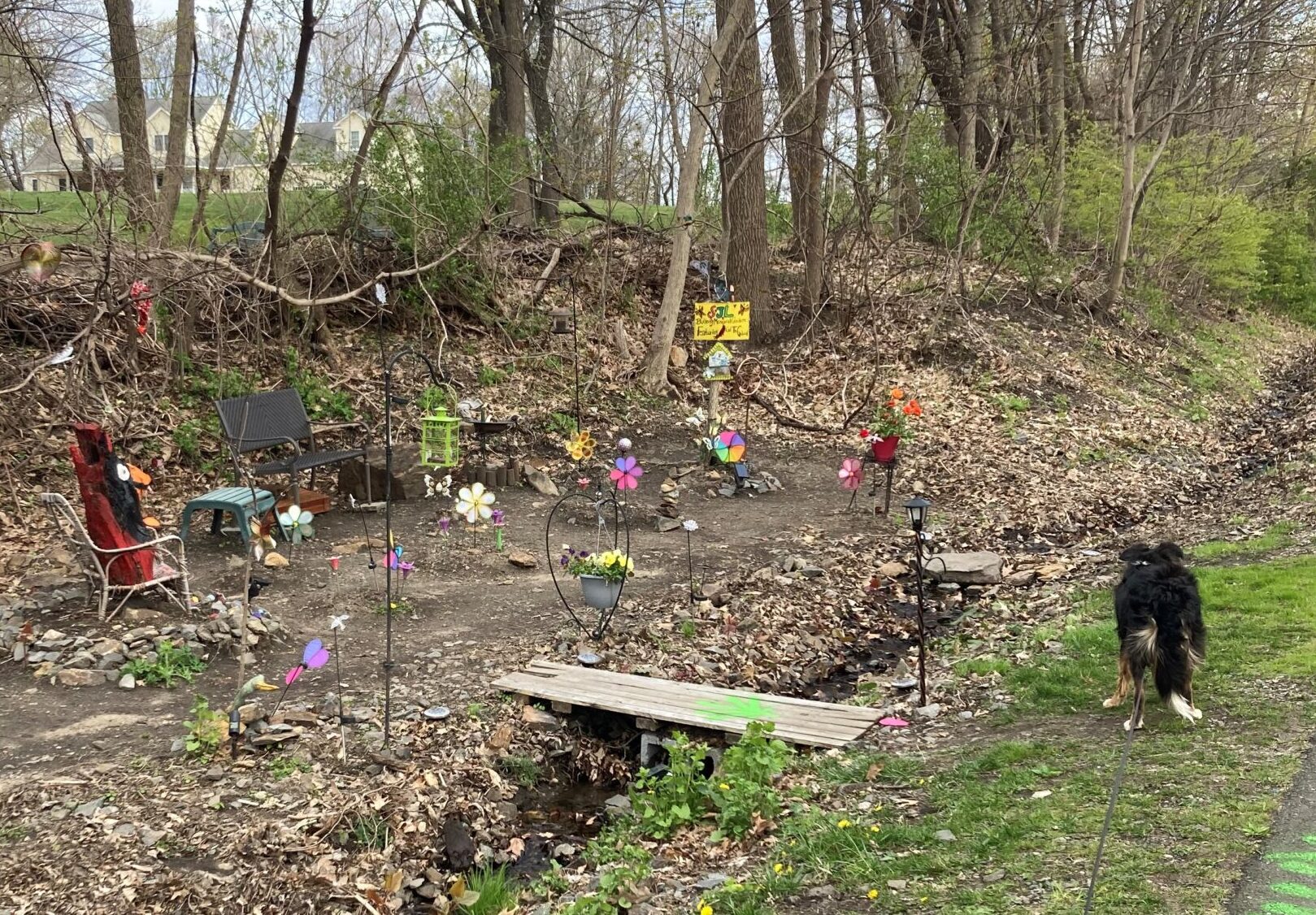
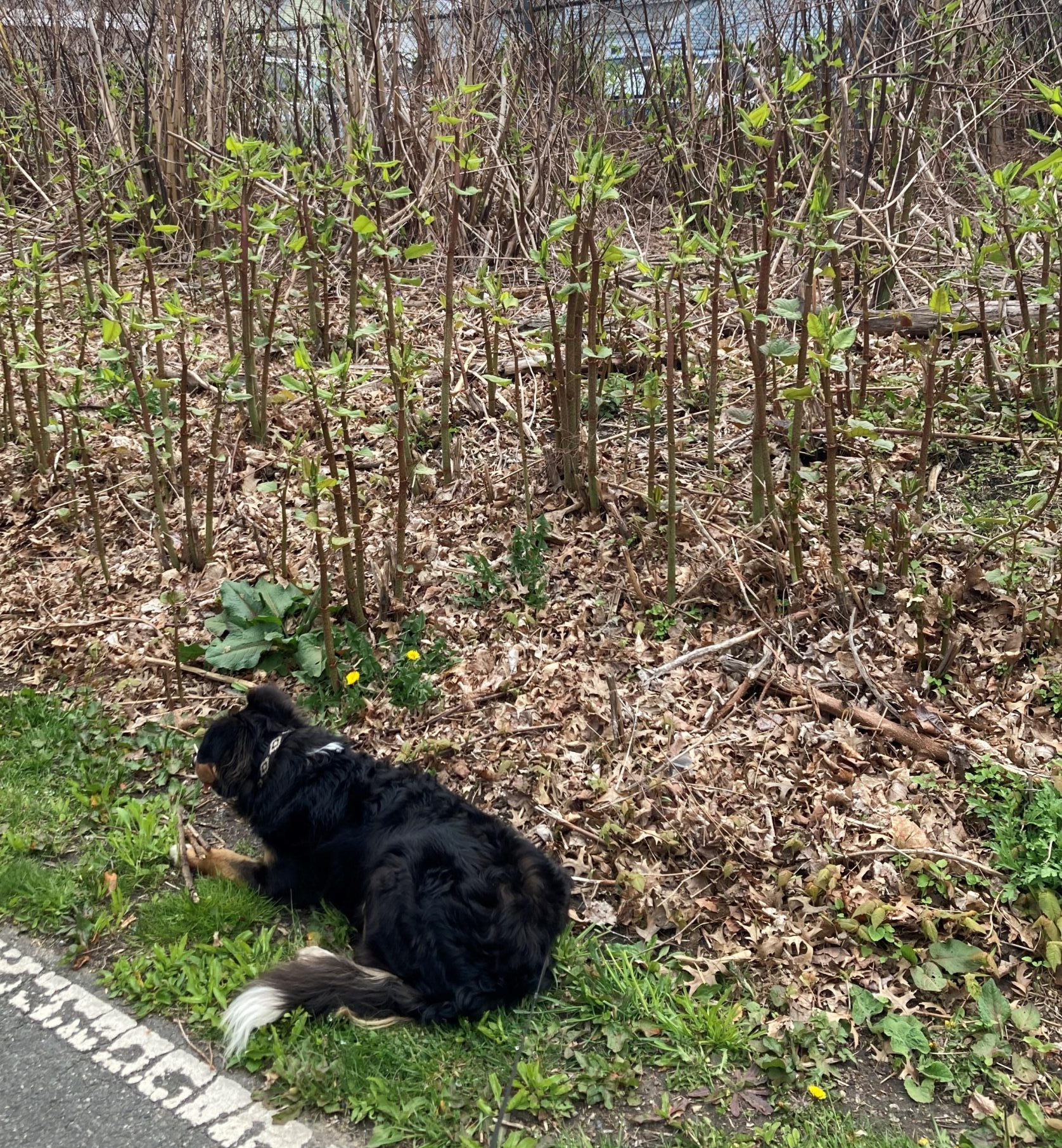
Our portion of the trail is paved, with a painted intermittent yellow line running in a regular staccato fashion down its middle, and follows a serpentine route through woods and meadow.  Houses are close by in the beginning, but there are bushes, weeds, vines, and trees that separate us from our neighbors.  In the spring, summer and early fall, these plants create a green wall, punctuated with flowers of various colors, insulating anyone on the trail from the enveloping city.  It’s easy to ignore the sounds of cars, lawn mowers and the general throb of urban life and feel that one is strolling through a tunnel of nature, far from the madding crowd.  In the winter, this wall becomes a hodge-podge of intertwined sticks of various sizes — a godsend for Waldo.  There are many different species of plants here, the undergrowth in places dominated by Japanese knotweed, and I’m sure that they all put root to soil through arbitrary accident (with one exception, a small Covid-garden alongside the trail), rather than by the intentional hand of man.  The number of different species is copious and bears testimony to the fecundity of the natural world, left to its own designs.

After a quarter of a mile, the trail crosses Ash Street.  Here the nearest houses retreat from the path — it’s as if human habitation is slowly withdrawing from where we walk.  Oaks, maples, black walnut trees, along with trees of heaven, sumac, white pine and others, begin to dominate.  The undergrowth remains alongside the tarmac where it can still get sunlight, but further away from the trail, the trees dominate and the weeds and bushes become more anemic, then disappear.  After three-eighths of a mile, we cross Hudson Street and, soon after, forest wafts off into the distance as far as you can see, which is limited by the density of the greenery during most of the year.  In the winter, once the leaves are gone, you can vaguely see in the distance, through twig and branch, the surrounding city-scape, but the rest of the year the insulation is nearly complete.

After another three-eighths of a mile, we cross Boston Scientific Way, the entryway to a large corporate entity of the same name, and about one mile from our starting point.  Just past the street is a large open meadow that slopes gently down to Fort Meadow Reservoir.  The meadow is a landfill and has several pipes, two or three inches in diameter, stuck in the ground and topped with a curve that points the opening downward.  These are vents for any methane that may be produced underground, so it doesn’t collect and cause problems.  At the bottom of the hill is a two-laned highway, Route 62, that borders the water.  There are two causeways that cross the reservoir and the wooded hill on the opposite shore is packed with several large houses.  Walking along, looking across the landfill and the watery expanse, one could almost imagine that they were seeing a quaint Maine town on the Atlantic coast on a calm day, instead of a small piece of Marlborough alongside a reservoir.  It is particularly picturesque in autumn when it is bathed in the technicolor display of fall.

Soon after, some one-and-a-half miles from our starting point, we parallel Sasseville Way, cross Fitchburg Street and then follow close by Crowley Drive.  On our right is the fenced-in athletic field of the Assabet Valley Regional Technical High School.  Signs clearly state that it is verboten for the public to enter the grassy expanse, which is a real shame.  Alas, I would love to take Waldo off leash and just let him run at will in all that protected space.  Just past the field, the path continues through thick forest, on both sides, down to a tunnel that passes under the Route Eighty-Five Connector that is the end of Interstate Two-Ninety and the boundary between Marlborough and Hudson.  From there, now having gone more than two miles, the trail continues on in deep woods a little more than another mile to Washington Street, a busy thoroughfare.  Waldo and I turn around and head back just before then, a little more than three miles from our car, to complete our daily walk.

Waldo and I, we love this trail.


Brigham’s Bridge, a farm bridge built with no mortar.

Posted by Byron Brumbaugh in Walking with Waldo, 0 comments

December 7, 2021

My good buddy.


I enjoy waking up and not having to go to work.  So I do it three or four times a day.

-Gene Perret


When I decided to retire, I closed the chapter on work and moved on.  I have never been tempted to go back to work, even though I really could have.  When Covid hit, I was prepared to work or volunteer, but things never got so bad that I felt I was needed.  I guess not everyone is built to make a decision, walk away from a thing and never wonder if it would be better if their course didn’t yaw in a very different direction, but that’s what happened to me.  The decision was made and I never gave it another thought.

I never even have dreams about the Emergency Room.  I’m sure I suffer a little from PTSD – the trauma and stress was certainly there, but it feels like it was all in a different life, one that is no longer relevant to what’s happening now.  It seems to be more like a story I read once, than a life that I actually lived — interesting, but unreal somehow.  My current reality is all about sharing a life with Waldo, that includes all the mundane daily routines like eating, going to the bathroom and walking, and somehow assimilating everything.  There are still new adventures that I get involved in, like walking with Phyllis and Christine, rafting down the Snake River and a few other things, but mostly I’m drawn to connecting the dots that are the events that happened to me in my life.  Not so much figuring out the meaning of life as just trying to define the story.  And in my writing, setting the gist, if not the details, down on the page.  I can’t think of a better way of spending retirement.

We’re born into this life, a bunch of stuff happens, and then we die.  Maybe our lives don’t, in themselves, have any meaning, but that doesn’t mean that what happened was meaningless.  Maybe the meaning of life is the meaning we put to the life we live.  We get to choose the events in our lives that are significant enough to remember.  We get to draw the lines that connect it all together into some kind of coherent whole.  We choose the plot of what happened, the arc of the story and its denouement. These choices we make tell the story as we choose to tell it and, in the end, the choices we make define who we are and that is what gives meaning to our lives.

At this time of my life, coherence seems to be important.  I made choices, things happened because of those choices and that led to my making other choices.  Seeing that causal chain reaction in some detail is what I mean when I say that I’m trying to assimilate my past. If I can put it all together, I feel like I have grasped what there is to “understand” of my life.  And I don’t mean understand in an intellectual sense.  I mean understand in a spiritual sense.  To be able to hold it all in my mind at once, not as a collection of concepts or ideas, but as a feeling, a contiguous, ever evolving, conscious path of awareness from where I was in the distant past to where I am now.  If I could see that, I think I would give meaning to my life.

So, for now, I walk in the woods and do my best to be aware of the essence of life, to be present in what is happening now.  To get in touch with what is most important about life, that which is happening right now.  To hear the wind in the trees, feel the cold breeze on my face, to see, really see, the life around me as it prepares for the depths of winter and to smell rotting leaves and decaying bogs.  And, of course, to enjoy my life with Waldo.

Waldo is a gift from the gods.  He provides me with the opportunity to revel in love, a kind of love that isn’t intense and frenzied, as sexual love can be, but rather one that is warm and cozy, like a hot cup of cocoa on a cold winter’s day.  He is at the center of my daily routine and a source of satisfaction at the end of every day.  He is with me nearly every hour of every day and that has afforded us the opportunity to bond in a way we would never have been able to if I were still working.  Waldo urges me to get out of my chair, enjoy nature and watch him enjoy being in nature.

Waldo helps me celebrate the flow of the life I have left.


Love this kooky dog!

Posted by Byron Brumbaugh in Walking with Waldo, 0 comments

November 30, 2021

Ah! There’s a good stick!


Everyone thinks they have the best dog. And none of them are wrong.

-W. R. Purche


Waldo is a little over three years old and we’ve been together for almost three years.  During the time I’ve known him, I’ve seen him mature, learn how to cope with his environment and calm down.  He learned that he needs to stop when he comes to a street crossing and wait until I say, “Okay,” before he crosses.  It has happened that he doesn’t cross the street, despite my giving him the go-ahead, because he sees a car coming that I don’t see.  Border collies are well known for their energy, and Waldo is certainly no exception.  Although he still runs around in tight circles while he’s waiting for me to get ready to take him out (I don’t understand how he does that without falling due to a complete loss of balance and then puking!), he’s not as frenetic about it.  As a puppy, on the rare occasions when he would jerk the leash out of my hand, the retractable handle would wind the thing up and bang on the ground as it trailed after him, and he would be gone and out of sight (like that time in Hudson when I had to chase him down the road in the heat).  Now, when this happens, without cue from me, he stops and turns to look at me as if thinking, “What?  I didn’t do nothin’!”  He even sits, sometimes, until I walk up and grab my end of the tether.

Border collies are well known for being focused.  Most of the time, Waldo’s attention is fully consumed by whatever is driving him at the moment.  It might be a rabbit he’s spotted and he stops dead still, nose stuck out in front, head a little lowered, unblinking and staring at it.  It might be a stick he sees that appeals, most of them do in varying degrees, and he lunges for it, apparently thinking that if he doesn’t act fast, it will get away.  It might be that he is concentrating on moving forward, down the path, at a pace always faster than mine, as if all that matters is getting to the end of the trail.  Whatever it is that consumes him in the moment, it really consumes him – it’s like the rest of the world doesn’t exist.  In the past, when he was a puppy, that was almost impossible to break into.  Now, with a little encouragement, he will “Leave it alone,” or “Come,” or “Go this way.”

This border-collieness might seem a bit disheartening for some.  He may seem somewhat less affectionate than other dogs, like a golden retriever, for example.  Golden retrievers often nudge your arm, looking for a little attention, or come up and put their nose on your thigh, seeking a pat and a scratch.  Waldo will do that in the car, but it’s more because he’s nervous, doesn’t like to be in the car, and is looking for assurance and maybe some anxiety relief.  In other places, he’s off on his own, entertaining himself, except on those occasions when he wants to play.  He seems to be perfectly happy in his own company.

I really like that about Waldo.  It allows me to be content in my own company.  While Waldo is out on the balcony, keeping watch on his realm, I’m inside on my recliner, writing, reading, or watching television.  When we’re walking, Waldo is out doing his Waldo thing, leaving me to listen to the wind, photograph unfamiliar plants and smell the roses.  If one of us wants to play, we approach the other and we’re off pursuing a game of Waldo-stick, or tug-of-war.  That lasts for a bit, then we’re back in our own worlds again.  If I feel like I want a little doggy affection, I go up to him, give him a hug, talk to him lovingly and give him a scratch or two.  He responds with a wagging tail; he leans into me and maybe nibbles at my clothes.  That done, we’re off on our own again.

I couldn’t ask for a better companion.  He’s there when I want him and off on his own when I need me-time.  I’m there for him when he needs me and I leave him alone to be Waldo the rest of the time.

It took a while for our rhythms to synchronize, but we are now in resonance.  All it took was patience, close observation of each other and an interest in learning from the other what they needed and desired.  Now, Waldo truly is the best dog.

Ever.


Come on! Get a move on, would ya!

Posted by Byron Brumbaugh in Walking with Waldo, 0 comments

November 23, 2021

Fort Meadow Reservoir in fall.


When you arise in the morning, think what a precious privilege it is to be alive, to breathe, to think, to enjoy, to love.

-Marcus Aurelius


It’s late morning when Waldo and I start out on the rail-trail today.  The days are colder, but not so cold that I have to dress in my parka – yet.  Still, I would have had to wear a jacket, if we had gone earlier, and I knew it would be warm enough I could go in shirt sleeves, and not freeze, if we waited.  It is now a tolerable 54 ℉ and a little chilly, but after a couple of miles, I will generate enough body heat so I’ll be comfortable.  It’s a little warm for Waldo; he seems to thrive when the temperature is in the low forties, but you wouldn’t know it to watch him.  He’s out of the car and bounding down the path, soon pulling at the end of the leash.  I only know that this temperature is a little more than he would prefer by past observation — he will have his tongue hanging out before we finish.

In about six weeks, at the winter solstice (December 21), the sun will be only 24.1 degrees above the horizon when it is at its zenith in Boston.  Now, it is nearly noon and yet it is still close to the horizon.  That means that shadows are long, despite the fact that it’s the middle of the day.  The sun shines obliquely on the trail, the trees, the grass and Waldo and me.  That makes the day cooler, but also less glaringly bright.  Fall days are beautiful, with bright reds, glorious oranges, and still some vibrant greens, but the lighting that shows off these colors is less direct, more subtle than in summer.  The shadows give everything more depth and contour as well, showing off the texture of an oak’s ridged and riven bark, or the grain in a weathered old plank on a rail fence.  This effect disappears on days with overcast skies that erase shadows, and everything seems very flat.  Once snowfall has covered everything, the reflected light from the icy whiteness also aids in removing shadows.  But today, it’s nice and sunny, the ground is clear and the visual texture of nature is palpable, adding to the artistic flair of autumn’s technicolor display.

The leaves of more and more trees are turning color.  The sumacs have gone past their bright red phase and are turning a dull brown.  Birch trees have already lost most of their leaves that are now yellowed and cover the ground.  Many of the maples have turned red or orange, although there are some trees that still sport greenery.  If you look carefully, you can find maple leaves that are in the process of turning.  Between the veins, the leafy flesh that fills that space, the venule, is bright red, yet the part of the leaf abutting the veins is still green.  The contrast in these colors, bright red next to vibrant green, is very striking.  I’ve seen birch leaves that have a more gradual color change from red, to orange, to yellow, then to green, all in a fractal-like pattern, that are gorgeous.  Many mighty oaks still hang onto much of their green, stubbornly in denial of the coming winter.

There are also white pine needles on the path.  They aren’t there because of fall — after all, they’re conifers.  But they’re not impervious to a strong wind and we had quite a storm, a nor’easter, a few days ago.  The pines themselves stand tall and green, seemingly unaware of, or perhaps uninterested in, the colder temperatures.  Yet their organs of photosynthesis are all over the ground like those of their cousins, the deciduous oaks, maples, sumacs, birches and all the rest.  Mother Nature exacts a price for her change in seasons and leaves and pine needles are fodder for her cannons of cold icy winds.

My attention shifts to Waldo, who wanders along the way, searching out every morsel of experience he can find – all the sights, smells, sounds, textures and even (yuk!) tastes on show before him.  It makes me wonder why I never noticed, really noticed, what was always there right in front of me all my life.  Only in the past few years have I been completely open to experiencing the beauty all around me.  Then I remember.  It’s like what Moat said to Jake Sully in the movie, Avatar, “It’s hard to fill a cup that is already full.”  My cup has always been so full, my attention turned elsewhere, my mind engorged with the demands of the moment, that I had little psychic energy for anything else.  Now, all those other things, career, bank account, things I own, superficial interpersonal relationships — the bread and butter of life in your twenties and later, seem so unimportant, almost irrelevant.  I am eternally grateful to Waldo for providing the impetus for me to find the world as it is.

And I now get to do it every damn day.


Big-tooth aspen leaf in late fall.

Posted by Byron Brumbaugh in Walking with Waldo, 0 comments

November 16, 2021

CUBA! How the hell did we get to Cuba?


Only those who are eager to get lost in the wilderness of life’s beauty can find a meaningful life.

-Debasish Mridha


We walked two more legs of our BCT trek, about a week apart.  The first leg was around fourteen miles long, going from Ashland to Sherborn, and the second about twelve miles, going from Sherborn through Medfield to just south of that town.  Christine was able to join us for the first part, but it was only Phyllis, Waldo and me for the second.  This country, about thirty miles or southeast of Boston, is rolling hills, forests of mostly oak, maple and white pine, with bogs and meadows in the low places.  The temperature on both days was cool, but not so cool there weren’t any mosquitoes.   There were way too many mosquitoes.  I lathered myself up with some Ultrathon, a cream developed by the military that contains DEET, but is not absorbed through the skin, and they weren’t too bad.

As I’ve mentioned in previous blogs, we often get a little lost before we finish the trek of the day, a delay that usually costs us a mile or so and sometimes up to an hour, and the trip from Ashland to Sherborn was no exception.  At one point, we did a double-take at a license plate on a car that was parked along a street where we walked.  The plate plainly said, “Cuba” above the usual string of numbers that license plates have.  Now, that is definitely lost!  We never found out the story behind the car, but were definitely amused by the find, enough to take a picture.

Most of these walks are very pleasant.   I especially like the jaunts into the forests, climbing up and down the hills, making our way through the exposed tree roots and large rocks.  Phyllis really likes the boggy areas, particularly where someone has put elevated wooden paths through the muck so we can be in the mire without being in the mud.  Christine likes the beach but is game for just about anything and Waldo, he loves it all.  As long as the path has a stick somewhere nearby, he’s good to go.

On the second of the two trips, Phyllis and I were particularly amused by two BCT markers that appeared on the same tree.  About a foot apart and both just above eye level, one marker pointed to the left and the other pointed to the right.  Now how could anyone possibly get lost with obvious directions like that?  We resorted to using the online interactive map and found our way okay, but even this ploy is wrought with difficulty.  The map shows a satellite view of the ground around us with a blue pulsating dot where we’re located on the image.  In good times, there is a thin red line that represents the trail that is overlaid on the satellite view and, if we’re on-trail, passes through our blue dot.  Not infrequently, however, the red line either fails to come up, or it disappears altogether if we expand the image to get a better idea of what’s going on.  The trail is so serpentine that it is often necessary to blow up the image so we can tell just which way to go.  Somehow or other, we are always able to get back to our car, even it means we have to stumble an added mile or two to do it.  Like Phyllis says, though, “Where’s the fun if we don’t at least occasionally get a little lost?”

Waldo, heck, he knows exactly where he is.  He’s right here, right now.  Always.  And, since he has no goal, he can’t get lost.   As long as there is a trail to be trod and plenty of sticks to move around, what does it matter where he goes?  In his experience, no matter which paths we take, or what we confront, all trails lead to home.  I sometimes wonder if he finds that rather magical.  Sometimes, I find it kinda magical too.

At the end of our second walk, we round a corner in the street we’re on and find our car where we left it in an unimproved parking lot just south of Medfield.  Our next trek will take us just north of Gillette Stadium, where the Patriots play.  We’re getting ever closer to our final destination, Kingston Bay, Duxbury, but that is still many miles away.

Arriving home, Waldo plops over on his side, as he is wont to do, and, after catching his panting breath, is standing at the bedroom door, asking to be let in to go take a nap in his crate.  But he doesn’t fool me.  I know for a fact that all I’d have to do is say, “Wanna go outside?” and he would be up on his feet, impatiently trotting around in circles, eager to hit the trail, any trail, one more time.

Me?  I’m grateful I can put my weary muscles in my beloved recliner and lean back.

Yeah, I was a little lost today, but now I am so found.


Well, it’s clear which is the right way to go…

Posted by Byron Brumbaugh in Walking with Waldo, 0 comments

November 9, 2021

Follo9w the yellow brick road!


Always hold fast to the present.  Every situation, indeed every moment, is of infinite value, for it is the representative of a whole eternity.

-Johann Wolfgang von Goethe


The sun is up!  And Waldo and I are out and about.  That’s our default condition, I suppose.  Christine texts me in greeting, wanting to know what Waldo and I are doing.  I answer, “WWW,” which covers it pretty well and has become a standard response.  Today, we left in the morning, around 8, and we invite her to join us, but she’s busy doing other stuff – she’s one busy woman.

Waldo’s trotting up ahead, at the far end of the leash, sniffing and picking up sticks.  I do my best to relax my attention and widen my sensory sweep to include as much as I can – everything happening around me I can see, hear, feel or smell.  It’s amazing to me how much I usually miss, just because I’m not paying attention.  What is right there in front of me, when I do pay attention, is wonderous, indeed.  Today, everything is still so very green, except a few of the leaves that are starting to turn.  The birch trees have lost many of their leaves and cover the trail with a yellow blanket that reminds me of the Yellow Brick Road from The Wizard of Oz.  The oaks and most of the maples still carry much of their verdure proudly and the contrast of yellow trail beneath a green umbrella, having just a touch of red and orange, is magical.  It makes me feel like I’m waltzing through the Garden of Eden.  Birds are singing and bugs are buzzing, making the experience seem more immediate and alive.  The smell of moist earth from the nearby ponds, and the musty odor of decaying leaves underfoot gives depth to the ever-present now.

Paying attention to what’s happening around me gives my life a sense of wonder and magic.  I remember a time when I was idly watching out my airplane window as the airliner I was in flew above some wispy white clouds.  I have often seen the shadow of a plane on the clouds below, but this time, the sun, clouds and plane were positioned just right and the shadow was surrounded by a beautiful rainbow halo called a glory.  Something similar, called a brocken spectre, can, on rare occasion, be seen by climbers on the top of a mountain when they look at misty clouds below them and the sun is low and behind them.  I’ve been on the top of many a mountain and never seen a brocken spectre, but the glory I did see.  Once, I was flying a Cessna in Nevada through some virga (light rain that falls from the sky, but evaporates before it hits the ground) and a rainbow appeared that was a complete circle!  It hung there, right in front of us, and then we flew through the center of it!  On the top of Kilimanjaro, I saw nieves penitentes – rows and rows of short vertical sharks-teeth of ice, all aligned parallel with the wind.  These only appear at the peaks of very high mountains where the temperature and air pressure are low.  And, right here on the rail-trail, not so long ago (as described in a previous blog), I noticed steam venting off wet wooden fence rails, leaving a misty rooster tail across the path, emblazoned by the golden light of a low early-morning sun (I wouldn’t be surprised if it had a name, but I haven’t yet learned what this phenomena is called).  It all is so wondrous and beautiful.

But things don’t have to be rare to be appreciated and adored.  Back, many years ago, when I was scuba diving, I would descend eighty to one-hundred feet to the bottom and spend a whole tank of air just looking at what was around me within a nine square-foot area.  Rainbow-colored tube worms, lumpy abalone, an awesome variety of coral, sea anemones, and schools of fish are all part of the kelp forests off the Southern California coast.  I just had to move my gaze a few inches and I would see something new.  Adjusting the buoyancy compensator so I effortlessly floated a few inches above the bottom, I could watch what was there in a small space and be totally entertained until my air got low.

The same thing is true of the places where Waldo and I walk.  If I just pay attention in detail to the common everyday things around me, the trees and bushes, the squirrels and chipmunks, the flowering plants and weeds, the birds and bugs, the rocks and earth, all in a wonderous variety, I can be absorbed in fascination.  I don’t have to be an entomologist to be awed by bugs, an ornithologist to be wowed by birds, or a geologist to be interested in rocks.  All I have to do is open my senses and let the resulting experience into my stream of consciousness.  The fact that I can do that at all is magic.

I love to watch the way Waldo, once his paws hit the trail, joyously falls into just that frame of mind.

He gives me a fine example to follow.


There’s still green here.

Posted by Byron Brumbaugh in Walking with Waldo, 0 comments

November 2, 2021

Phyllis and Waldo on the trail.


Hundreds of butterflies flitted in and out of sight like short-lived punctuation marks in a stream of consciousness without beginning or end.

-Haruki Murakami


Phyllis, Waldo and I pick up where we left off on the Bay Circuit Trail in Callahan State Park, Marlborough — about eight weeks ago.  Christine is otherwise involved today and won’t be joining us.  The map I have indicates that we will be walking about twelve miles to our next stopping point in Ashland.  The trail takes us through more of the park to the west, then down along the eastern shore of Sudbury Reservoir and finally ends up next to Mill Pond in Ashland.  Much of it is in wooded areas, and some is along streets and highways.  It’s a perfect day for a hike – the temperature is in the high sixties, the sky is clear, there is little wind and the previous night’s rain has mostly soaked into the ground.

So far, we are a little past halfway on the BCT and it’s starting to look like we may have some difficulty finishing it before the first snow.  I do not want to walk through the woods with more than about three inches of snow on the ground; it’s just too much work.  With that in mind, we decide to walk the twelve miles even though we’ve been off our feet for a bit and are a little out of shape.  The spirit is willing, I just hope the flesh isn’t too weak.  Ah well, as Christine would say (quoting Navy Seals), “Embrace the suck.”

The fall is a great time to walk in the woods.  It’s cool, most, but not all, of the mosquitoes are gone and the ground is firm and still snow free.  There are muddy wet spots in the low places where we have to negotiate our footfalls along downed logs and rocks to avoid sinking into the mire (of course, Waldo could care less), but they aren’t many.  The trail starts out narrow and winding, but, as we get to the reservoir, it widens and straightens out into something a four-wheeled ATV could easily follow (although they are verboten).  The trees are mostly green still, with only a smattering of yellow and red leaves.  It’s late September and in years past, this would be the time for peak colors, but global warming has changed all that and things don’t get really colorful until well into October these days.  There are still plenty of dead leaves, left over from last fall, laying on the ground, and only a few of the recently fallen.  The weeds and undergrowth are starting to retreat a bit, but in the woods, there isn’t much of that anyway – they just can’t compete for the sunlight they need because it’s shadowed from the ground by the trees.

Waldo trots along, up at the forward end of the leash, as if walking on these trails is what he was meant to do.  Maybe it is.  His heritage may be one of sheep herding and farm work, but he has spent most of his life out walking through nature on various trails.  If he were working for a shepherd, even if he really liked it, he would still be performing a task required by some human.  Out here, I pretty much let him go where he wants and (mostly) do what he wants.  I just try to keep him out of trouble, out of the mud (as much as that’s possible) and away from danger.  He spends his time reacting to whatever instinct urges him to do, driven by something that is totally canine.  He is answering the call of Waldo, not the whistle or call of some homo sapiens.  I love to watch him just be a dog.

I, too, have learned how to be free floating out here.  To synchronize my stream of consciousness with the constantly shifting currents of nature around me.  To change what I put in my mind as the mood strikes me.  Oh, my mind is still consumed by human ideas and current events, and Phyllis and I spend much of our time talking about them, but it’s all free association and I’m not trying to solve some problem or other that’s besetting me.  One of the great things about retirement is that life doesn’t deluge me with things that must be done – not nearly as much as when I was working.  Now, I spend much less time responding to the whistle and call of other people and more time just following my inner navigator.

We do take a moment, here and there, to snack on what we brought along and, of course, to water Waldo.  Even with the pauses, my back hurts before we finish – enough so I have to stop more frequently than usual and stretch the muscles.  But I can make do and we arrive at our destination, deliciously tired and ready to go home and rest.  It turns out, after some wrong turns and backtracking, we walked fourteen miles in seven hours.  Next trek will be another twelve miles, or so, down to Sherborn.

We just won’t wait eight weeks until we do it.


It’s not just Waldo that carries poles!

Posted by Byron Brumbaugh in Walking with Waldo, 0 comments