

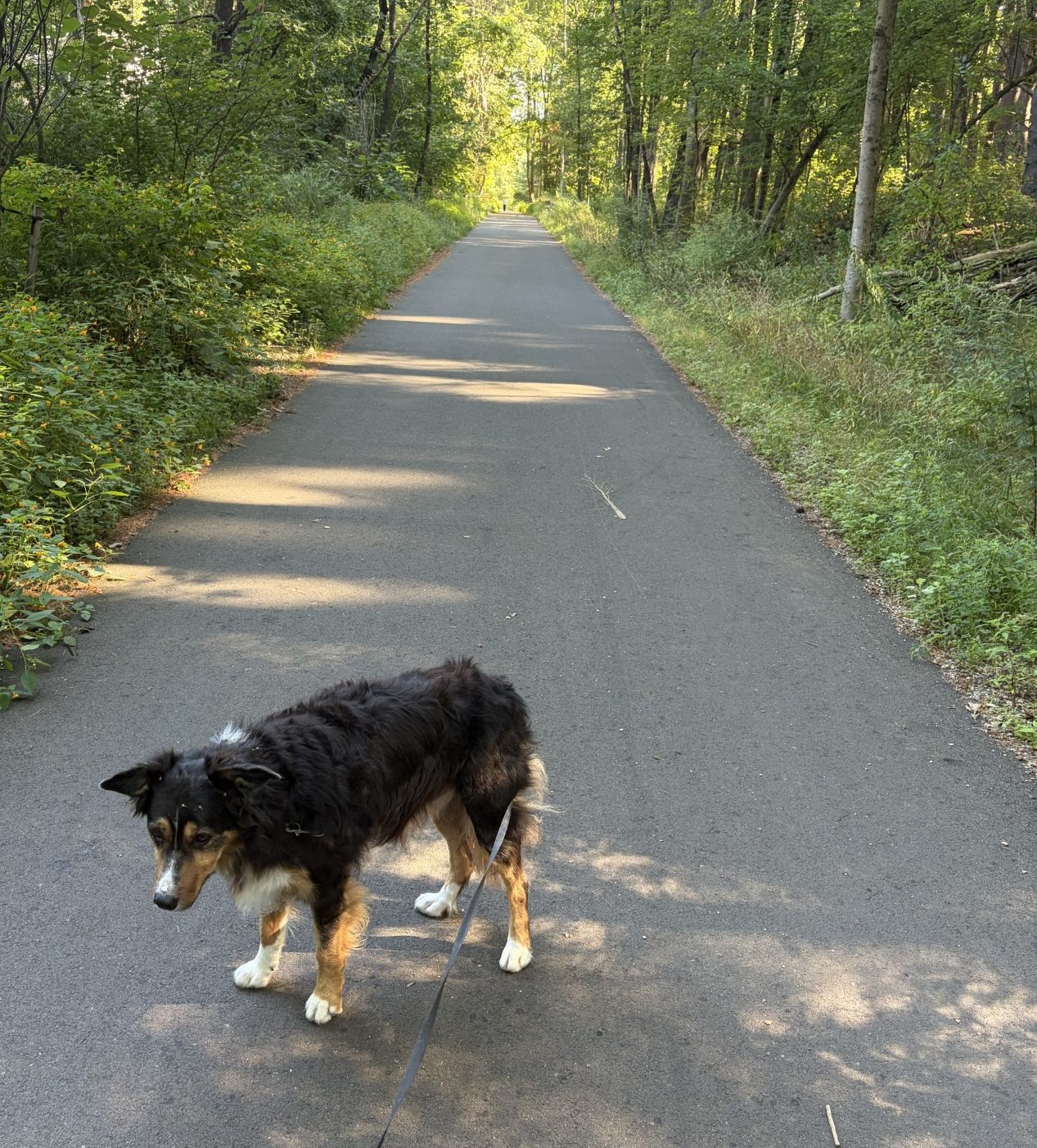
The completed Bruce Freeman Trail.
Variety is the very spice of life, that gives it all its flavor.
— William Cowper
The Bruce Freeman Trail (the finished, paved part) runs a little over 21.25 miles pretty much due south from Lowell to Sudbury, Mass. Waldo and I have walked the whole thing (including the unpaved, unfinished part that continues into Framingham) in the past, some sections more than once. In earlier incarnations, the trail was the Framingham and Lowell Railroad, operated in its later years by Conrail. The last train to travel on it down to Sudbury was in 2000. The last pieces of the railroad to carry a train anywhere was in 2006 to 2008. The first part of the Bruce Freeman trail opened in 2009. Just this last year, the piece from Concord to Sudbury opened to the public, although many (including us) used it before that.
Today is a clear sunny day with temps in the high 60s and it seems like a good time to revisit the trail and see how the southern portion has changed since its completion. We start at the South Sudbury Train Station, at the spot where the Bruce Freeman crosses the Mass Central Rail Trail, and head north. Weeds have had a good year and grow up and over the tarmac, making it look narrower than it is. Places where white paint on the pavement once read, “ROAD XING,” now read, “OAD XIN.” The trail runs in a straight line north for as far as I can see.
For the first half-mile or so, we’re walking in the back yards of commercial buildings off to our right. One thing that is new is that several signs have been put up that provide a history of the place. One of the signs explains why there are light signals (old, rusting and no longer functional) in the middle of nowhere, next to what once was the railroad. It takes a long time for a big heavy train to slow down, so these signals were put up a mile from an intersection to warn the engineers if they needed to slow down before they got there. Other than historical signs like that, little else has changed since we were last out here.
We cross over a street and walk beside a very large commercial nursery to our left. It belongs to the Cavicchio family and used to be their family farm. The story goes that Henry Ford came into the area and wanted to build an assembly plant nearby, but the family refused to sell their water rights out of fear that the plant would pollute the water. Because of that, and other reasons, the plant was never built. Even so, Ford did leave an imprint on the area, but that’s another story for another time. After the nursery, we’re deep in forest green.
Waldo is having a good time. I swear he enjoys going to new places as much as I do. His gait is totally normal and he’s lost in the plethora of sensory input that bathes him. He has a propensity to want to trek off onto any dirt paths (of which there are a few, wandering off whither, I don’t know) that veer off from our paved path. When he isn’t doing that, he’s prancing in the weeds just to the side of the tarmac. I swear the dog loves to bushwhack. Fortunately, there is no burdock around and only a very little ticktrefoil.
There aren’t too many people out here – it is midmorning and midweek, after all. We pass a few joggers and a few people walking their dogs, but there seems to be more bicyclists out here than what we normally see on the Assebet Trail. The Bruce Freeman does run through the town of Concord, a couple of miles further north, which is a ritzy part of the state, and Sudbury itself is known to have a lot of money. Perhaps that means that the percentage of people who enjoy being outdoors is skewed a bit in favor of bicycles, I don’t know.
As we penetrate further and further northward into the woods, the nature of the plants growing off-trail changes. At first, the trees are mostly deciduous, mainly oaks. A bit further along and the trees are mainly white pine. Where we’re walking, the trees were almost all cut down over a hundred years ago, to clear the ground for farming and grazing. By 1850, the land was pretty much stripped of trees. Then things opened up out west, where the land was better suited for farming, and people moved on, leaving the land a chance to recover. Today, the forest has returned and the farmer’s fields, with few exceptions, are gone. The trees there are, though, are mostly younger than 50 and very few are older than 100 (you can tell by the diameter of their trunks).
After just over 3 miles, we turn around and head back to the car. The temperature is increasing into the low 70s and Waldo’s tongue is starting to loll out and flop around. I should have brought his water along, but I didn’t. I failed to take into consideration that, whereas the air temperature may be on the cool side, the sun beating down from a clear sky will make things hotter.
About 1.5 miles from the car, I notice a water fountain next to the trail that I didn’t see on the way out. The thing that grabbed my attention was that it has a specially designed piece for filling water bottles. I’ve never seen anything like that before. Then I look down and, right next to the ground, there’s a basin sporting the same kind of faucet as on water fountains built for humans. But the basin is way too low for any people to be able to use, even a young child. It is, however, placed perfectly for a dog to lap up his fill. “Waldo, want some water?” I ask.
Waldo immediately goes to the basin and paws at it, apparently also recognizing what it is for. I push a button, water flows into the basin, and Waldo slakes his thirst. There really is a lot of money out here if someone has gone to effort to provide a doggy water fountain for thirsty canines on this rail trail in the middle of the woods.
The doggy now rewatered, we continue on our way and are soon back at the car. It has been a very pleasant walk. We’ll have to come out here more often.
But, first, we have to finish the Midstate Trail.
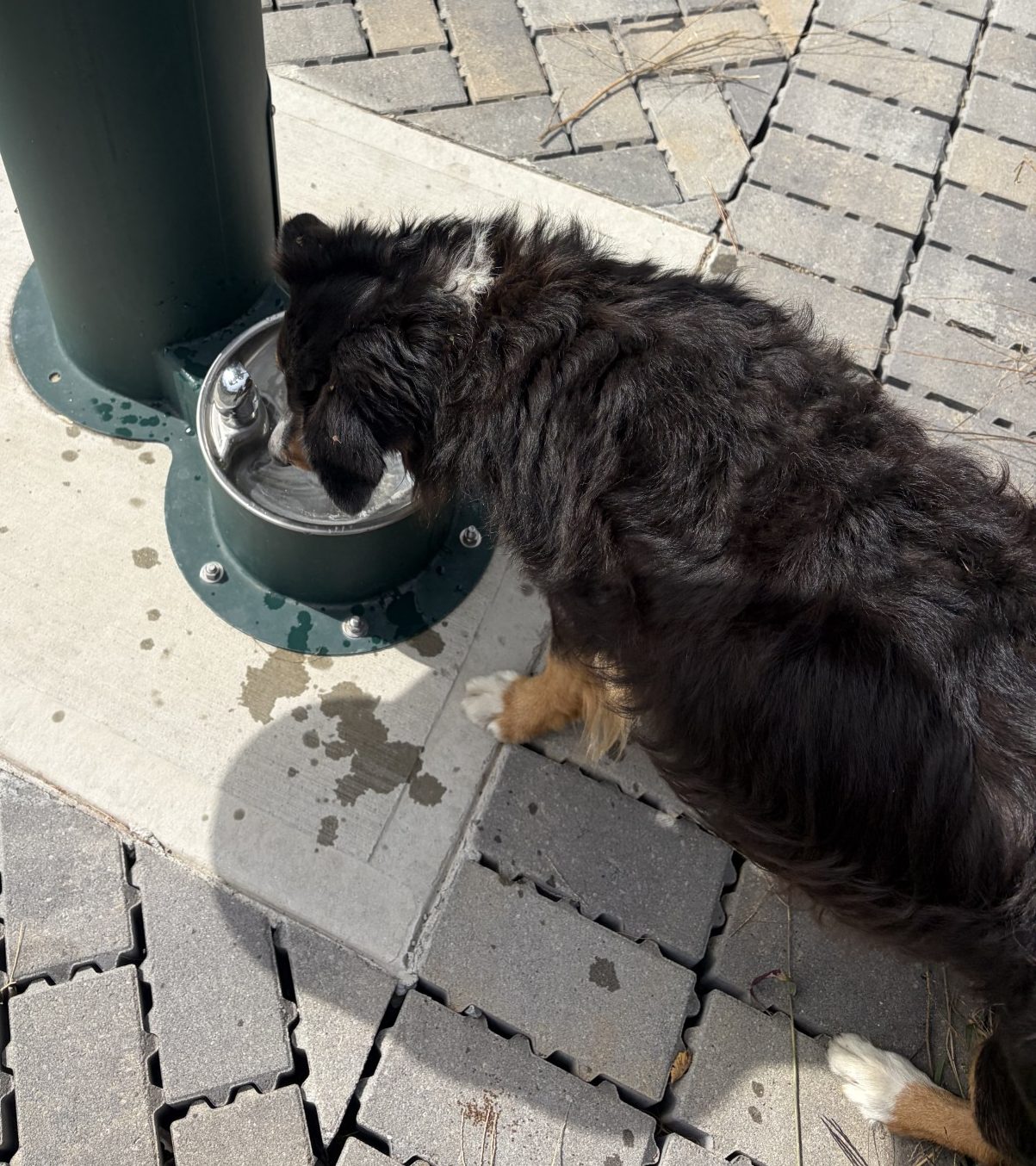
Waldo enjoying the doggy water fountain.