

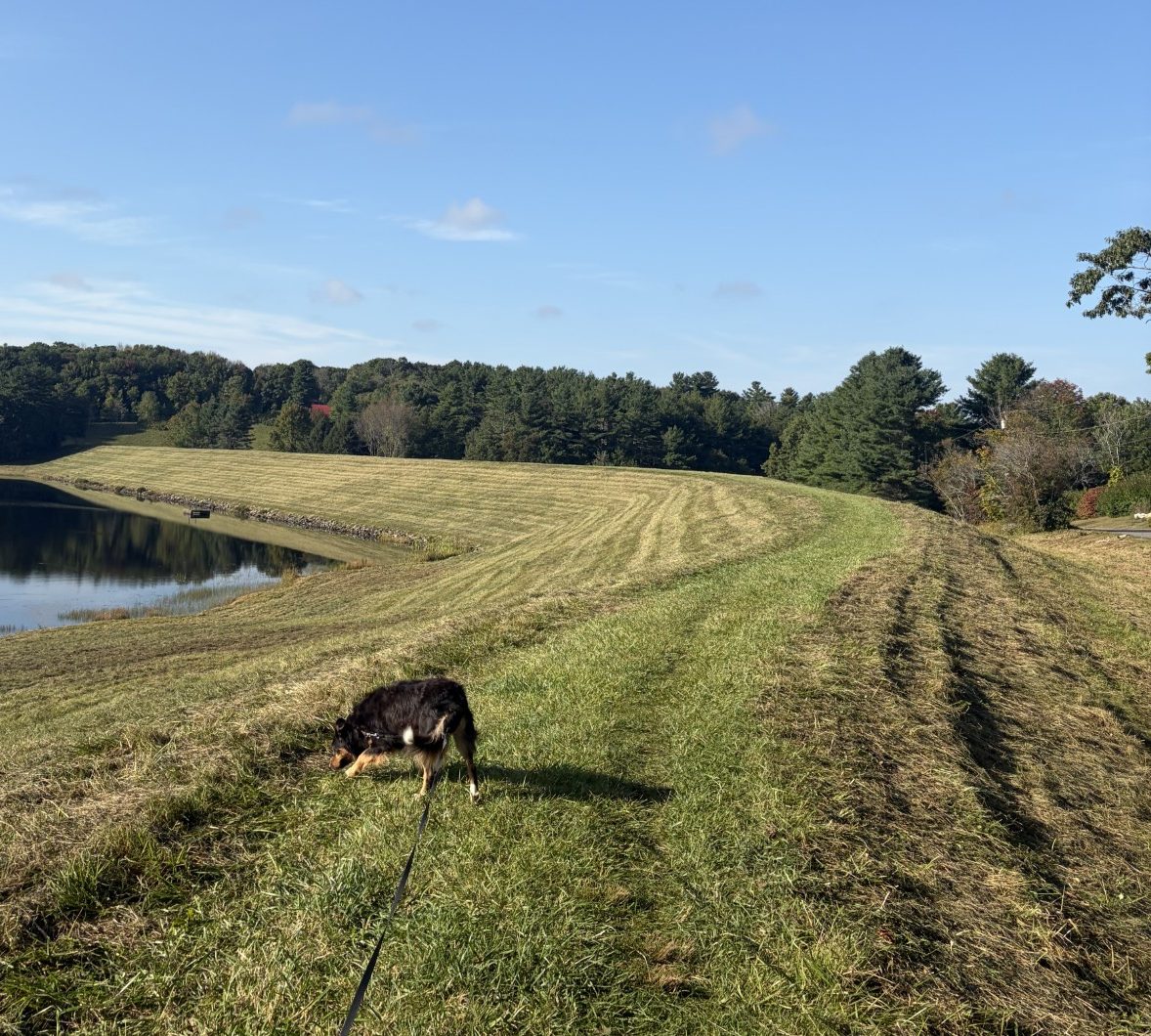
We start along the top of a dam.
The poetry of the earth is never dead.
— John Keats
Today, Waldo and I walk the first half of our next 6-mile leg of the Midstate Trail. We are only doing ½ of the leg because we have to do it round trip, so we can get back to our car. We start from where we left off last time at the Moose Hill Flood Control Site – a pond created by a high earthen dam. From here, we will walk a little over 3 miles, then turn around and retrace our steps. The temperature is in the high 60s to low 70s, just cool enough for Waldo to go on a prolonged walk. The sky is mostly clear of clouds and there is only a slight breeze.
After parking the car, Waldo and I follow the trail across the earthen dam. It is covered by mown grass, but has a recognizable trail running down its center. To our left is a large water-filled pond and to our right, the dam slopes down into a vale that houses a paved road. As we cross the dam, there are people and machines mowing the grass off to the side. At the far end of the dam, down near the water, a tent is pitched and I can see two fishing poles, standing alone, with lines in the water. There are 2 men in the tent. “Catch anything thing?” I ask.
One of the men answers, “Nope. We must not be very good fishermen.”
“Maybe there’s no fish,” I reply. Waldo and I walk on.
After a quarter of a mile, or so, the trail turns left and disappears into oaks, pine and brush. There are a lot of ferns here, mostly sensitive ferns, so the area must be fairly wet most of the year – despite global warming and el niño. We did have a mildly wet spring and summer. The trail is narrow with many exposed roots, and is covered by boot-pounded dead leaves and pine needles. The ferns and brush only appear alongside the trail. Off deep into the forest, the ground is mostly bare of undergrowth, because of the dense canopy of leaves above.
Waldo is off at the extreme front end of the leash, pulling slightly in his eagerness to get on with it. There is no evidence of a limp. Although there are places where it is not at all obvious where the trail runs, he seems to know exactly where to go and winds his way through the undergrowth as if it was obvious. His only navigational hiccups occur at trail bifurcations and intersections. There, he pauses, looks down one option, takes a step or two, stops and then turns and looks down another option, with a step or two in that direction. After a period of indecision, he makes a choice and heads down a trail. It is almost always the wrong choice.
“Where you going?” I call out.
He stops, turns around and goes through the same process of indecision until he makes another choice. This continues until I get caught up to him and it becomes obvious which is my choice. He then runs off in the “right” direction, reassuming his position of lead and we’re off. After all these years and miles, it is a real pleasure to be out here walking with him.
We cross a highway and the trail continues down a country lane. We haven’t gone far and we pass a sign, in the weeds just off the road, that reads, “Original Home of Polar Spring Water, c. 1882.” I didn’t know that Polar Springs was that old. Looking around, I see nothing but weeds. No old buildings, or even abandoned foundations. There are no cleared areas and no evidence of any kind that something once happened here. The only water I can see are some muddy puddles that don’t seem at all appealing. Curious.
Moving on, we pass by some houses and broad grassy fields on our right, then the trail turns off to the left and runs into the woods. A sign tells us that we are now in the Mass Audubon Burncoat Pond Wildlife Sanctuary. It is a 680-acre landscape of forest, fields and wetlands, home to deer, fox, otter, racoon, beaver, coyote, fisher, muskrat and bear. There are a variety of birds that can be seen here, including wood ducks, great blue herons, sparrows and warblers. However, they must all be in quiet hiding, because we see and hear none. The ambience is idyllic, though, as we make our way down the path.
We turn around and head back to the car after going just more than 3 miles. When we get back to the dam, the fishermen are still there. “Catch anything yet?” I call down the dam to them.
“Not yet!” they call back.
“No fish!” I say, and Waldo and I continue on to the car.
We walked 6.81 miles, with 657 feet of elevation gain, in 3 hrs, 34 min. I am hot, sweaty, a bit sore and definitely fatigued. Waldo’s tongue is out, but I swear he’s smiling. I water the dog and we get into the car and head home to food, rest and a nap.
After a day or two of rest, we’ll be back at it and finish this leg of the trail.
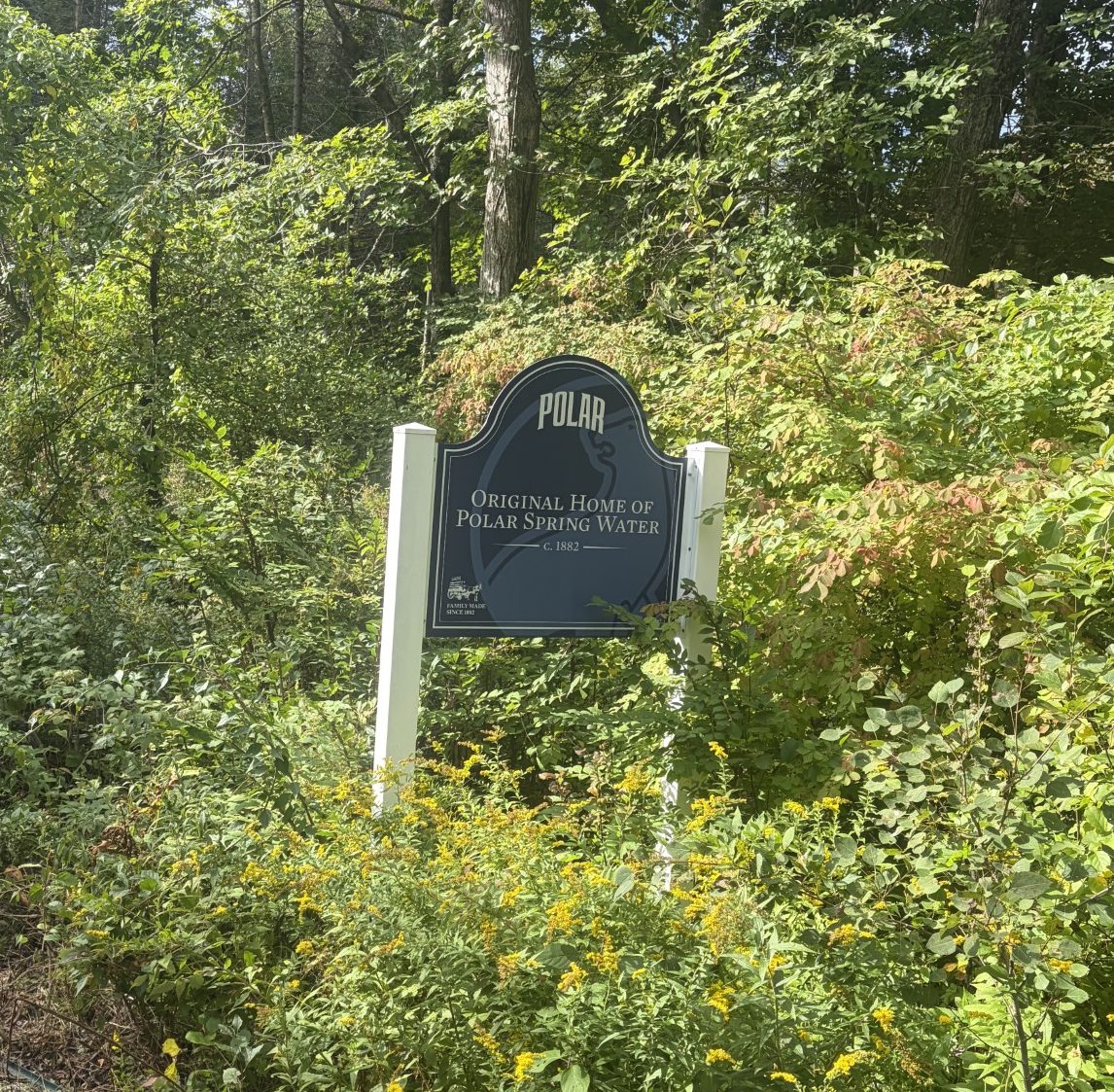
Okay, but where?