
Walking with Waldo

July 11, 2023

Damn, that’s green!


Education is not the filling of a pot but the lighting of a fire.

-W.B. Yeats


June has been a strange month.  There were some very hot days in May, with temps in the nineties, but June has been mild.  Every morning, Waldo and I get up early and go for our six-mile sortie into the woods, not because we need to beat the heat, but because we can.  Sometimes, when we start, it’s a bit chilly for me in my shirtsleeves, but Waldo, in his sable birthday suit, is quite comfortable.  Before we’re done, though, I’m sweating and Waldo is dropping sticks so he can pant.  It makes for a very pleasant walk.

Mother Nature is fully greened-out now.  We’ve had a good amount of rain, which has helped, and early summer has arrived.  I have some favorite places along the trail, mainly because the density of trees and bushes provides a good amount of shade, but also because the verdant atmosphere is somehow welcoming and comforting.  It feels kind of like coming home.  But the trail really has no places that aren’t surrounded by foliage, moss or grass.

As we walk along, we come across a busy street and Waldo stops and sits, waiting for me to tell him it’s okay to proceed.  Cars come by and their drivers are waving at us to cross.  “I’m training the dog,” I say in response and wave them on.  There is a waving competition that goes on for a while, the goal being to be the one that persists in waving the longest, but I always win.  I have it in my mind that if Waldo ever gets loose and tries to cross a street, then he will, from habit, stop and wait for cars to pass before he proceeds.  Will it work?  I dunno, but it can’t hurt.

One of the things that seems to be different about getting older is that I now have this insatiable urge to pass on important lessons I’ve learned along the way.  I suppose some of this is biological in origin, since human offspring develop so slowly and need to be cared for by their parents for so long.  Especially in today’s complex world, there is so much that needs to be learned before an individual can function on his own.  So, my impulses to teach aren’t directed only at Waldo, but also at my grandchildren.  Sadly, neither is very interested in listening, though.

There were so many struggles I went through as I was growing up that I really would like to talk to my grandchildren about.  Not as entertaining stories, at least not all the time, but to pass on important insights so they won’t have to learn them on their own.  Like, we are our own worst critics and hold ourselves back more than anyone else.  I remember well, at a young age, being afraid of failure and causing that failure by not trying very hard in school — I wouldn’t do all of my homework or read everything assigned.  The subliminal thought was, I could always say that I didn’t really fail because I never really tried.  At some point, I figured out that was bass-ackward.  If I really tried at some activity and failed, then it only meant that I just wasn’t born with what was required to perform that activity and it was by no fault of mine.  I also discovered that if I approached an endeavor with the attitude of, I will just see what I can do, without the conviction that there is a limit to what I can do, I could do more than I ever dreamed was possible.

I watch my grandchildren struggling and my heart goes out to them because so much of their pain is self-inflicted.  I, too, went through what they are going through, but made it to the other side.  Why can’t I just save them the trouble and tell them the secrets of how to do it so they don’t have to struggle?  Somehow, it just doesn’t work that way.

But then, I’ve found out that at least some of it does leak through the fog of growing up.  Decades after telling my daughter something, she has come up to me and said, “You know, I remember when you told me…”  I had no idea she was even listening.  So, maybe, there is some of what I have to teach that is being learned.

Waldo and I continue on our way and soon are amongst the ferns and moss.  A cool breeze carries the happy songs of birds going about their daily business.  A musty scent of damp earth wafts our way and the shadows of leaves dance on the ground in synchrony with the wind sighing in their branches.  Squirrels chase each other through the bushes and insects buzz around us.  I don’t need to teach Waldo the essential importance of all this.  He already knows.

I just wish I could pass it along to all those who are too busy to bother.


Gates to the Green Wood.

Posted by Byron Brumbaugh in Walking with Waldo, 0 comments

July 4, 2023

Cinnamon fern.


True life is lived when tiny changes occur.

-Leo Tolstoy


The days have turned cool, with highs in the mid sixties and lows in the high forties to low fifties.  And rain.  But the rain is kind of stuttering — mostly easily avoided and, when not, it’s usually more of a heavy mist than a hard rain.  Waldo likes this cooler weather to walk in and is in his element.  Although now June, the mosquitoes haven’t yet come out in hordes and the worst of the bugs are troublesome gnats.  And ticks, of course.  Waldo likes to wander into the weeds and he picks them up as if advertising for tenants.  Because of his black fur, I can’t see them, but I can feel them when I pet him.  Some of the weeds he brushes up against are poison ivy.  Fortunately, I’m not allergic and have never had a reaction to the stuff.  Yet.

Two days ago, while we were on the rail-trail, I noticed some ferns that had tan stalks stabbing skyward in the middle of their usual green fronds.  They stood out so flagrantly that I was amazed I’d never noticed them before.  Curious, I speciated them on my Picture This app.  Cinnamon ferns (Osmundastrum cinnamomeum), they were.

The plant is perennial and the cinnamon-colored stalks are fertile fronds.  In mid to late spring, the tan spike-like fertile leaves grow in the center of their sterile green brethren. On these spikes are small beady capsules that contain spores.  After the release of the spores, the spikes die back and become inconspicuous.  Today, I can find only a few of the cinnamon-colored stalks.  That explains why I never noticed them before.  The stalks, although easily seen when present, are not present for very long.  If I wasn’t looking at the right time, I would miss them.  I seem to frequently be reminded of how inobservant I can be.

One of the things that I’ve learned to watch out for is the English ivy tree.  While standing out in the deep, hard winter, because it’s one of the rare plants that still has green leaves, in the spring and summer, it’s not so noticeable.  Not only are there leaves everywhere now, the English ivy leaves are obscured by an overgrowth of other vines.  The tree these vines grow on is dead, but it provides a vertical trellis that lifts the plants skyward where their leaves can get more sun.  Even the ivy leaves on the ground are buried by other growing things.

Since the coldest part of the winter when I noticed the English ivy, I’ve also been following the appearance of garlic mustard.  It grows close to the ground and I can find it except in the coldest of times.  In the winter, the leaves are small and their clumps scattered.  Now the leaves are comparatively huge, some more than three times their winter versions.  And it’s present in most places I look — except where invasive weeds like Japanese knotweed has taken over.

Speaking of Japanese knotweed, it has now reached maturity and stands more than ten feet tall.  Its leaves so densely cover their stalks that I can’t see into the thicket of the stuff further than about a foot.  It doesn’t grow everywhere (yet), but where it does, there is almost nothing else growing where it stands.  In late summer, I have seen a bind weed growing in and over its top, but it’s not prolific.  Clumps of Japanese knotweed, tens of feet deep, grow in long hedges that parallel the trail for hundreds of feet.  I worry about it someday taking over the entire trailside, but it’s not close to doing that yet.

It may be my imagination, but it seems to me that there aren’t as many sticks around the trail as there used to be.  Poor Waldo is often reduced to picking up the tiniest of twigs to carry around.  Can it be that Waldo has been so efficient at stalking and herding the native sticks that he’s cleaned the place out?  I doubt it.  After all, he doesn’t move them somewhere else, he just carries them around for a while, then drops them at his feet.  It’s been some time since he grabbed one end of a long branch and dragged it down the trail, though.

All this points to something the ancient Greek philosopher Heraclitus said: “The only constant in life is change.”

And life goes on…


The English ivy tree is covered by more than English ivy.

Posted by Byron Brumbaugh in Walking with Waldo, 0 comments

June 27, 2023

Life in all its wonderous magic….


Life is pleasant.  Death is peaceful.  It’s the transition that’s troublesome.

-Isaac Asimov


The day is going to be a hot one, so Waldo and I start out on our walk early, just after dawn.  The sun is up, just a few fingers above the horizon.  The day beckons.

But not for everyone.

As Waldo and I move through Mother Nature, passing through the oaks, the maples, the black walnuts, the trees of heaven, the sumacs, the elms, the sassafras, the white pines and all else that is now so very green, my mind is somewhere else.  We are swaddled in a blanket of vibrant life with all its chirping, buzzing, swishing in the breeze, rustling in the leaves and effusing a gemish of wonderous odors that my poor olfactory organ can’t possibly sort out, but I’m not here.  I’m thinking about Lee, Phyllis’s husband, who has died.

I never met the man, but I know a little about what his last years were like, from what Phyllis has shared me.  He was 78 when he passed.  Phyllis has been involved with Lee for about the past two years, married for the past six months.  At the time of their meeting, she was seventy-three and he was three years older.  Both had been married twice before.  About three years ago, Lee’s last wife died of cancer.  Two weeks later, he was diagnosed with terminal prostate cancer and was told he would live about another two or three years.  Lee didn’t want to live out his final years alone and looked for a companion.  Phyllis and Lee met each other on the internet and Lee was up front with Phyllis about his diagnosis and prognosis early on.  Lee’s oncologist told Phyllis that Lee would be fairly healthy up until about two months before his death and then he would quickly deteriorate.

From the first, the two of them were very happy.  They enjoyed the camaraderie and intimacy that couples share and the company that brightens the shadows of old-age loneliness.  There were some points of friction — Phyllis is physically active, Lee not so much.  Phyllis likes to travel, walk long distances, ride a bicycle and paddle board.  Lee liked to stay at home and cuddle on the couch.  Compromises were made, but Lee wasn’t in good enough shape to keep up with everything Phyllis wanted to do.  After frank and open discussions, Lee decided to give Phyllis the space to do what she felt she needed to do.  Phyllis cut back on her daily routine to spend more time with Lee on his terms.  Phyllis truly enjoyed cuddling on the couch and Lee, although disappointed at having to let Phyllis go off on her own, never punished her afterward when she returned to him.  Phyllis felt guilty at leaving Lee to pursue adventure, but enjoyed the time she spent with Lee.  It was a balance that worked.

Over a year and a half, Lee’s strength and energy slowly diminished and he was able to do less and less.  There were good days and bad days, but, gradually, it all too often became a problem for him to even walk the quarter mile from his house to his mailbox.  And for a long time, there would be days when he could walk a couple of miles with Phyllis and even went biking with her.  Buying electric bicycles helped somewhat, but, as the tomorrows crept at their petty pace, the days when Lee had the energy to do any of that became fewer and fewer.

Prostate cancer usually metastasizes to bone – which means that cancer cells are shed from the primary tumor in the prostate, then travel to bones.  All kinds of bones.  There, they become lodged and rapidly start reproducing.  In the process, the bone gets eaten away and becomes weak and brittle.  This also causes pain.  As time went on, Lee started experiencing pain in his right arm, then his left leg and his pelvis.  This also decreased his mobility and ability to get around.  Metastases to his skull behind his right ear made him dizzy and nauseous.  Radiation therapy slowed things down a little, for a little while, but it’s no cure.  As time went on, one problem would be ameliorated to just be followed by another and with quicker and quicker succession.  Pain became more and more a part of his everyday life.

Eventually, bones started breaking.  Lee’s right humerus was broken in two places and needed surgery.  He went into the hospital and within two weeks, he required surgery to his left femur for similar problems.  These surgeries required not just the placement of rods, but the bone was so damaged that cement was also required for stabilization.  For the last three months of his life, Lee was in and out of the hospital and in rehab, recovering from these surgeries.

Commensurate with all this, for about the past year, Lee became more and more uninterested in eating.  Over his last five months, he lost a good fifty pounds.  While recovering from the femur surgery, Lee became so disinterested in eating and drinking that he was given a choice.  He would either agree to a feeding tube going into his stomach or he would be put on hospice at home.  Lee decided to go on hospice and went home.  When he got home, he was in excruciating pain whenever he was moved.  He was given pain medication for comfort, but that was inadequate therapy and he suffered greatly.

Over the last three months of his life, he slept more and more.  In the end, he was awake only about four hours a day.  There were moments when he was lucid, but he became more and more confused as time went on.  He would talk about his previous wife as if she was still alive and sometimes just made no sense at all.  Eventually, he became unconscious and lay quietly in his bed, with Phyllis at his side, holding his hand.  His respirations became shallow and more infrequent, then one halting breath led to a long pause, followed by another, then no more.  He was gone.  He was home for about a week when he died.

Over my Emergency Career, I have been witness to a lot of death.  Death is an old friend who I’ve interacted with many times in many circumstances.  I’ve argued with the grim reaper and done my best to beat him back, loose his grip, dissuade his intent and send him on his way.  Sometimes I was successful, sometimes not.  In the end, I came to see him, not as the enemy, but as an inexorable force that is as natural as birth.  It wasn’t death that I disrespected, it was suffering.  Suffering, too, can be difficult to avoid, but by focusing on that, I wasn’t fighting the laws of nature, just negotiating with them to be kinder.

Lee’s last few years were a slow deterioration that accelerated to a breathtaking rush in the end.  He was so lucky to have found Phyllis.  She provided him with companionship, intimacy, caring, physical and emotional support, and just plain old humanity.  Even though he had other family, without Phyllis, he would have spent so very many of his last days suffering alone.  Phyllis was a godsend.

But the benefit of the relationship wasn’t Lee’s alone.  Phyllis also received the same gifts and had a few years of togetherness that many older people are bereft of, as they approach the end goal that is common to all of us.  In addition to the wonders of love she shared with Lee, she gained the magical gift of making a profound difference in another person’s life, just by being there, at his bedside as he died, lovingly holding his hand.  Loving kindness is the greatest gift there is in life and it is so simple in its execution, yet so profound in its impact.  And each and every one of us has the power to give it every day, every hour of every day and minute to minute.

The moment is calling to me.  Waldo is tugging at the leash, the magic of Mother Nature is tapping my shoulder, seeking my attention.  I’m still alive and creeping in my own petty pace toward the inevitable.  But, I have not yet been given an expiration date and, I believe, that is still some ways off.  Meanwhile, I’m not alone.  I have family, friends, Waldo and all the beauty and magic that surrounds me.

And that is so much more than enough.


…and in all its subtle depth.

Posted by Byron Brumbaugh in Walking with Waldo, 0 comments

June 20, 2023

COVID Garden.


Walking is a man’s best medicine.

-Hippocrates


Things have been a little too cool at sunrise for a shirtsleeve walk and a little too warm two and a half hours later, for a jacket walk, when we finish.  So, Waldo and I have been waiting until eightish or ninish AM to start our daily sojourn into the woods.  The sun is well up by then, but the shadows are still long.  They lay across the tarmac and grass in blurry blotches, as if the projector, the sun, that produces them were out of focus (it sort of is, due to the fact that it isn’t a pinpoint source of light and that causes the fuzziness).   Soon, it will be hot enough that we have to start before dawn – but not yet.

The Japanese knotweed now stands some eight to ten feet high.  I can’t tell exactly because the taller stuff is a few feet away from the trail where I can’t see the ground due to all the foliage.  Orange jewelweed is still close to the ground and doesn’t yet have its orange blooms.  The trees of heaven are not at full height and their serrated pinnate leaves still have a reddish tinge.  There are new-growth Norway maples, with large green leaves drooping from stalks that aren’t yet big enough to be called trunks, and some young sassafras treelets, with their dinosaur-footprint shaped leaves, growing close by the trail.  These low-growing plants are all packed close to the trail where, due to the gap made by the tarmac, sunlight can still reach them without being blocked by the canopies of the larger old-growth black walnut, red oak and birch trees.  Thirty feet off-trail, there isn’t as much brush at all.

As soon as we hit the trail, Waldo is off doing his business, then he goes off on a search for the perfect stick.  He waters a few bushes and weeds along the way and is soon lost in his own Waldo-world, doing his Waldo-thing.  He’s eager and happy, quite entertained by everything around him.

Within the first quarter-mile, we pass the Marlborough COVID Rock Garden.  It’s a patch of gravel set in the grass next to the trail with a sign that reads, “Take one, Leave one, Share one.”  It first appeared during the lockdown of 2020.  Sometimes when we pass by here, there are brightly painted palm-sized stones, colored like easter eggs.  Sometimes I see beautiful skillfully painted rocks covered in intricate patterns that must have taken some time and effort to produce.  Today, however, there’s nothing but gravel.  All the good stuff must already be taken or shared.

Just before the half-mile mark is the COVID Community Garden.  Its modest beginnings date to the beginning of the lockdown and preceded the rock garden by a few months.  There is a couple that comes by and cares for the patch of ground on which it sits and have added to and improved it over the years.  There are planters and pinwheels and gnomes and photocell-powered lights and benches to sit on and carved and painted pieces of wood.  Flowers transferred from greenhouses and colorful pieces of sculpture are there as well.  People, particularly kids, walking along the trail will often pause and enjoy the ambience.

Shortly after the one-mile marker is a large open field, a landfill, that runs down a gentle slope to the Fort Meadow Reservoir.  Homes on the far side of the reservoir sit close to the water’s edge with docks that stick out into the lake.  There aren’t many boats out there, but I have seen a rowboat or two, bearing fishermen with lines out.  Swans and ducks are often in the lake as well.

Between the 1.5 and 2-mile marker is another field, quite large.  This is the athletic field belonging to the Assebet Valley Regional Technical High School.  Often when we pass, there are students out there, throwing a discus, a shot, or a javelin, or playing lacrosse or soccer.  It’s fenced in and I’ve often lusted for it as a place I could take Waldo, let him off leash and watch him run to his heart’s content.  Unfortunately, the fence bears a sign that says, “No Trespassing.  Violators will be prosecuted to the full extent of the law.”  Sigh.

At the 2-mile marker is a brand new, huge, not yet completed, luxury retirement home.  A little more than half a mile after that is an old stone bridge abutment and an elderly housing building that was built three years ago.  Some of the people we pass, as Waldo and I walk along, live there.  There must be a lot of money in retirement homes.

Just before the three-mile marker is the English ivy tree.  That plant is the hardiest I’ve seen.  Its green leaves are out and photosynthesizing in snow and -32℉ weather and still doing it’s green thing in 90℉ weather that’s too hot for me to do my thing and certainly too hot for Waldo and his sable birthday suit.

Just after the three-mile marker is a large rock that marks where we turn around and head back home.  The trail continues on into Hudson, but it’s more urban and less interesting.  Besides, six miles is plenty for a daily jaunt and even Waldo is quite satisfied after we’re done.

That’s a brief rundown of our daily walk, for the past four and a half years.

It’s our own little patch of Mother Nature that Waldo and I look forward to visiting nearly every day.


Fort Meadow Reservoir and a lot of green.

Posted by Byron Brumbaugh in Walking with Waldo, 0 comments

June 13, 2023

Shadows fall long this time of day.


An early-morning walk is a blessing for the whole day.

-Henry David Thoreau


The days have cooled off, for a little while, with temps in the low to high fifties range.  We’ve started walking in the morning, beginning around 8 AM, regardless of what the temperature is.  It’s always cool enough in the morning, but not too cool.  The shadows run from east to west across the tarmac, instead of west to east, as they do in the afternoon, long when we start, shorter when we return to the car.  It may be all in my head, but the morning light seems somehow different than the afternoon.  It seems bluer, cooler and gentler.  The afternoon light always feels more orange, hotter and harsher.  There is a definite difference in the wildlife – birds are more vocal, squirrels more playful and even the leaves appear greener and more eager to welcome the sunlight.

Waldo is back to normal, walking along at both ends of the leash, without laying down, nor even searching for shade.  He’s always eager to get up and get going in the morning.  True, he has business to do and, after a night’s sleep, probably always has an urgent need to take care of that need.  But, after he’s done, he romps and pounces, greeting the day with a playful vengeance.  Must be a morning person.

I, on the other hand, have always been a night-owl.  Even today, with no deadlines or legitimate requirement to do so, find myself with a second wind that keeps me up until close to midnight.  I am seldom eager to get out of bed in the morning, being more interested in rolling over and putting the day on snooze for a bit.  But, over the years when I had no choice, I learned that ignoring the urge to doze and just getting my ass out of bed when I wake up, makes it easier to get the day going.  Once on the rail-trail, I find it somehow more enjoyable to walk in the morning rather than later.

I’m not alone in this either.  Waldo and I meet several people this morning whom we usually pass when we walk in the afternoon.  Sometimes, we all walk in the morning to beat the heat later in the day, but some are there earlier on the cooler days when that isn’t so necessary.  Some are on bikes or rollerblades, and some are joggers.  I have never asked, but maybe some fit their nature-time around a work schedule and this is just what they have available.  There are others who we haven’t seen in a while because they always come out early.  They are, of course, morning people.

Some people we pass seem to be goal-oriented and are pushing themselves through their trek.  There is a teenager on roller skates, accompanied by a man on a bicycle, who goes rapidly back and forth down the trail as if he’s in training for some athletic purpose.  There are joggers who run faster than I ever was able to, when I could do that kind of thing, and there are bikers who speed along the trail, all spandexed up, with helmets and specialized shoes, on high-tech mounts obviously designed for racing.  I, personally, don’t think it’s safe to do that on a trail that is multipurpose and includes not only dogs, but old people with walkers, young kids who aren’t paying attention and babies in strollers, not to mention the squirrels and rabbits, foxes and even, rarely, a young deer, that on occasion dash across the path.  I can only hope that all those type As out there sometimes come out here to just enjoy the forest and all it has to offer – at any time of day.

This morning, I see the forest has passed a milestone.  The oak trees, initially a pale pea-green, have morphed into something darker and are becoming greener than the conifers.  They have shed their pollen and spindly stamens in one great flush.  Over a period of about three days, a blanket of green dust and ropy stems fell over the ground, covering cars and anything else beneath their canopies.  The tarmac turns that same pea green the branches were sporting, before they turned emerald, and windshields and their wipers are clogged with yellow fuzzy stems.  Pity the poor pollen-allergic asthmatic who has to endure this barrage.

Things are getting so much greener.  Weeds, like the Japanese knotweed that now stand eight feet or more high, bushes and young trees are all leafed out and obscure the line-of-sight into the forest after more than about thirty feet.  Things aren’t yet as verdant as they’re going to get, but they’re well on their way.

And mornings are such a beautiful time of day to witness it.


Shadows disappear when the sun goes behind a cloud.

Posted by Byron Brumbaugh in Walking with Waldo, 0 comments

June 06, 2023

Wide open spaces next to backyards.


It ain’t the heat, it’s the humility.

-Yogi Berra


I found a 4.7-mile-long rail-trail that runs through Leominster and Fitchburg, MA.   Leominster is about 20 miles or so northwest from Marlborough and the trail is just long enough for a good roundtrip walk.  The high temperature is forecast to be 70℉, so I feel comfortable starting at about noon.  Waldo and I meet Christine at the railhead in Leominster, where we leave our cars, and we head out.  I check my weather app as we start, and it’s 72℉.  I figure that as long as it stays below about 76℉, we’ll be okay.   If Waldo gets hot, we’ll just have to stop and wait for him to cool off in the shade here and there.

Leominster is a city of around 45,000 people, in the 2020 census, that was founded in 1653, incorporated in 1740.  During the civil war, it was a major contributor to the underground railroad. Originally a farming community, it became a manufacturing center after the arrival of the railroad. By the 1850s, paper mills, piano makers and comb manufacturers were doing business there.  The comb manufacturing industry was a big part of its industry with some 146 employees working in 24 different factories.  By the early 1930s, Foster Grant (yes, the sunglasses guy) brought plastic injection mold manufacturing to Leominster and the city soon became known as “Pioneer Plastics City.”  It’s also the home of Tupperware, founded in 1938 by Earl Tupper.

Leominster is  renown as the birthplace of Johnny Appleseed, whose real name was John  Chapman.  Born in 1774, he may be America’s first conservationist.  He was also a vegetarian.  When he was 18, he and his brother wandered west, creating a number of fenced orchards.  Pear or apple orchards were required by law to uphold land claims in many places and Johnny’s orchards became popular places for people to settle as the population moved westward.  At the time of his death, he owned some 1,200 acres of land.

Settled in 1730, Fitchburg is situated on the Nashua River.  It was a 19th century industrial center and used the river to power large mills making machines, tools, clothing, paper and firearms.  The 2020 census lists a population of around 42,000.  One of its claims to fame is that it was the home of Hiram Maxim, the inventor of the first self-powered machine gun.

The rail-trail starts in an small town urban area surrounded by streets and small businesses.  There are few trees, little shade and the sun is out, so it becomes quite warm as we walk along.  Oh, there are oaks and maples and the same bushes as along our rail-trail, just not as many and placed further back from the path.  As we walk along, we pass by backyards of one and two story buildings and even a ballpark, where little leaguers are playing baseball, watched by their families.  Before too long, we come across the Fitchburg Airport, someplace I’ve landed in my flying days, when the weather became too dense to make it back to the home airport.  After that, we parallel the North Nashua River and walk next to the Fitchburg Commuter Rail next to it.  Fitchburg is the last station on that line.  The train carries passengers to and from Boston several times a day and three pass us as we walk along.  We end up on narrow streets and alleyways in a rundown part of town, where we turn around and head back.

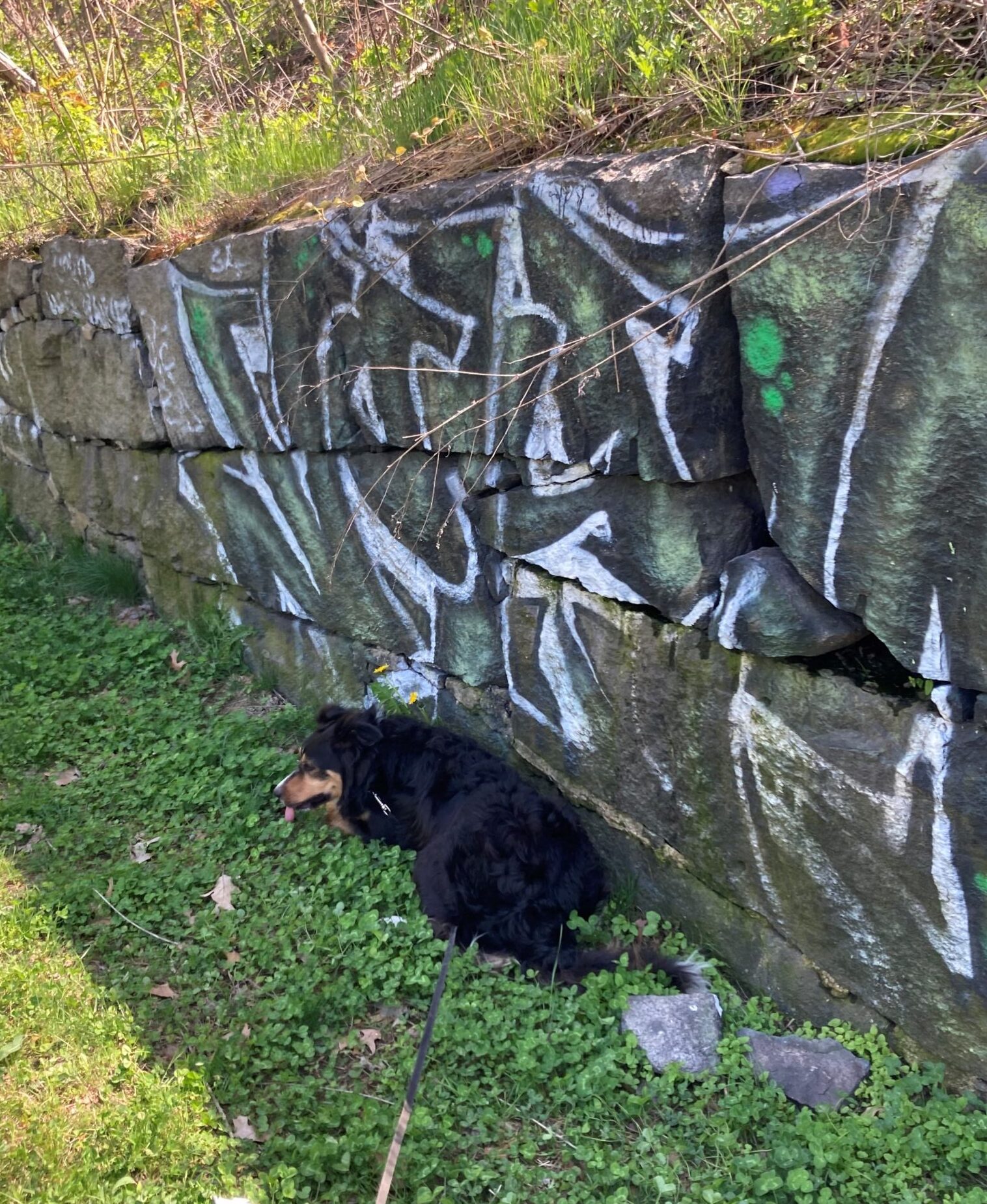
By this time, it has gotten quite hot.  I check my weather app and it reports a temperature of 76℉.  A lot hotter than the 70℉ first forecast!  I pull out Waldo’s water bottles and give him as much as he wants to drink and we carry on.  We don’t go more than a half mile before Waldo searches out shade next to a retaining wall and lays down.  Christine and I give him a few minutes to cool off and then verbally encourage him to carry on.  He’ll have none of it, though, and just looks up at us as if to say, “Uh-uh, I think I’ll just stay here a bit.”  I check the app – it says the temp is now 78℉.  Christine and I talk about it and we decide that Waldo and I will stay where we are and Cristine will walk back to the cars, about 4 miles, then come pick us up.  We could have waited a bit longer and Waldo would have continued on, but it’s hot, the sun is out, there’s little breeze and Waldo would probably need to rest up again before not too long.  Christine disappears around the next bend in the trail and Waldo and I wait.

Waldo lies on his side and seems to fall asleep.  Then, after about five minutes of that, he’s up and sniffing around.  He’s fine, just hot.  He and I find a nice big tree to rest under, with lots of shade, and after a little more than an hour, Christine comes and we’re on our way home.

The trail was not my favorite, it being so urban and all.  I much prefer tall trees with lots of shade and a forest milieu.  But I’m glad we walked it.

That’s one more part of Massachusetts the three of us can put on our been-there, done-that list.


This is what a spent Waldo in the shade looks like…

Posted by Byron Brumbaugh in Walking with Waldo, 0 comments

May 30, 2023

On the railroad bed.


Jobs fill your pockets but adventures fill your soul.

-Jaime Lynn Beatty


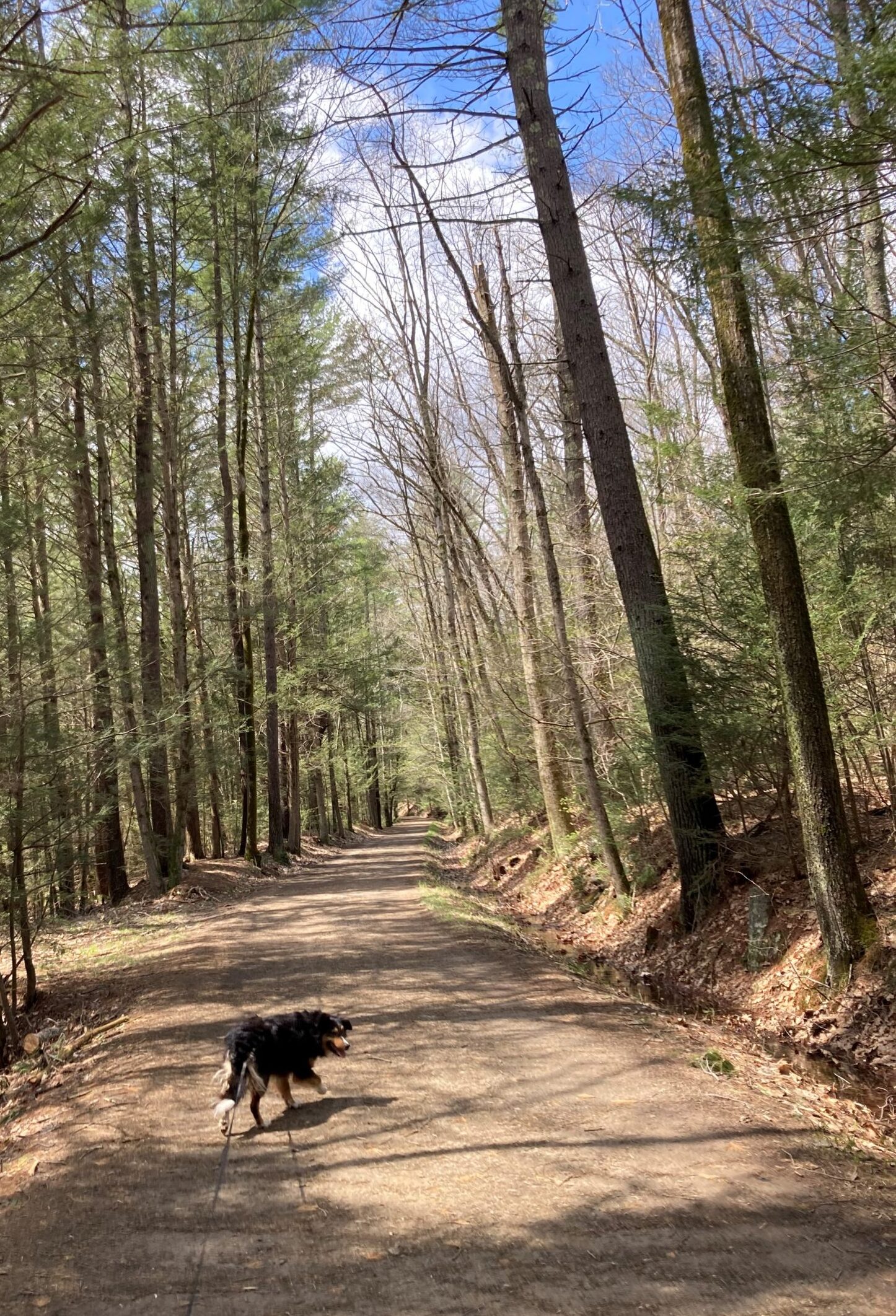
I found a 4.9-mile piece of the Mass Central Rail Trail that runs from West Boylston to Holden.  Today, Christine joins us for a round trip distance of 9.8 miles (we decided to do the round trip so we could use it for our daily 6-mile self-imposed obligation).  We start at about noon, in West Boylston, and head west, going upriver along the Quinapoxet River.  The day is cool, but warm enough for shirtsleeves, and the weather dry.  The path is wide, compacted and solid, but unpaved.  It starts where the river empties into the Wachusett Reservoir, just north of Worcester, and gently winds through stands of white pine that have been there for around a hundred years.

About a mile from the trailhead, there’s a place where the Springdale Woolen Mill once stood.  At one time, raw wool was processed there and then sent on by rail.  All that’s there now are some blocks of stone that made up its foundation.  What’s left is slowly being swallowed by the surrounding forest as it reclaims its own.  It seems to be an odd place to have a mill, in the middle of a forest miles from anywhere, but, I guess, all kinds of industry sprang up alongside rivers whose flows were a dependable source of power.  The Quinapoxet isn’t a big river, but big enough, I guess.  The mill opened in 1864 and, in 1905, the State of Massachusetts bought the mill and razed it to ensure the water quality of the Wachusett Reservoir.  The reservoir’s dam is in Clinton, Mass and the reservoir was finished in 1905.  It was first filled in 1908 and serves, even today, as a major source of water (along with the larger Quabbin Reservoir, further west) for Boston and its surrounding towns.

Not long after we pass the mill, we cross under Interstate 190 that runs south from Leominster to Worcester.  The highway is very high above us, supported on a huge cement trestle.  This trail is sort of an item on my bucket list.  I’ve spent many trips traveling to Worcester, looking down from on high, and thinking this would be a nice trail to walk.  It seemed sheltered and isolated, shaded and friendly.  It has proven to be all that and more.

All along both sides of this part of the trail are towering white pines, none of which is older than about 100 years (based on their diameter).  Oaks and maples stand further in the surrounding forest, but the rail-trail is swathed in pine.  The resulting ambience is that of an old European forest, like the Black Forest (Schwarzwald) of southern Germany, with lots of shade.  The river water flows briskly over rocks in its bed, providing a background symphony of white noise that is calming and soothing.  The atmosphere is peaceful and begs for a contented sigh.

Waldo enjoys the walk with its plentiful supply of sticks and many other people to say hello to.  This must be a popular trail for people from Worchester – we pass about twenty or so.  They provide Waldo with congenial pets and pats and give Christine and me smiles and kind words of greeting.  As we walk along, we idly converse about subjects so important that I can’t now, as I write this, remember much of their gist.  The perfect kind of conversations to have while walking with Waldo.  Some of the places our minds wander into are explaining why the trees are segregated as they are.  Christine believes the railroad bed must have, at one time, been open space.  Then, as they are wont to do, the pines moved in and, eventually, they’ll be replaced by the local brand of deciduous trees, including maples and oaks.  Real Earth moving, portentous stuff like that.

After a couple of miles, the trail takes a sharp 135 degree turn to the right and begins a serpentine climb over a ridge.  Clearly, we’re off the railroad bed as no train could possibly make it around these turns.  The trail remains broad enough to allow for a car and the steepness of the climb, although it does slow us down a bit, isn’t taxing.  Over the top of the ridge, the path continues in much the same way down to State Route 31, where it ends.  We turn around and head back the way we came, sorry that there’s no more to explore, but glad we still have the walk back to enjoy.  This is a walk we would very much like to repeat sometime.

But there are so many paths to venture down…


Off the railroad bed, downhill.

Posted by Byron Brumbaugh in Walking with Waldo, 0 comments

May 23 , 2023

There are a lot of rail-trails around where we live…


A walkway system can be a showcase of how existing features in a landscape – an abandoned railroad right-of-way… can be adapted… [to form a space] where people want to gather, explore and learn.

-Craig Evans


After the civil war, railroads sprang up just about everywhere there were sizeable centers of population.  This was particularly true along the eastern seaboard where most of America’s population lived and worked.  Increasing industrialization required that goods and products be moved large distances and as individual wealth increased, there was also the desire to travel to more distant parts.

Towards the end of the nineteenth century, people had essentially four choices of how to travel.  If there was a large enough river flowing where you wanted to go, you could go by boat.  There were horses you could ride, which wasn’t all that comfortable, or you could take some kind of wheeled conveyance or other, pulled by horses, which was pretty slow.  Or you could walk, which, for any significant distance, is both slow and uncomfortable.  The final possibility was you could go by rail.  If you had the money to pay for a ticket, and most people could afford it, at least occasionally, you could go by train.  The train was relatively fast, convenient and comfortable.  It was no wonder, then, that railroads sprung up in a web that crisscrossed nearly everywhere anybody wanted to go.

Then, in the early twentieth century, along came the motorcar and paved roads, and railroads largely disappeared.  They left behind these sweeping, serpentine, more or less flat roadbeds that were perfect for an easy stroll.  In the latter twentieth and early twenty-first centuries, some people repurposed these right-of-ways for leisurely walking and the rail trail was born.  Today, there are a plethora of paths, some paved, some in gravel, around where I live.  In Massachusetts alone there are 69 of the things, covering 347 miles.  In Wisconsin, there are 101, spanning nearly 2,000 miles.  There is even a trail, The Great American Rail-Trail, planned to run, contiguously, 3,700 miles from Washington D.C. to La Push, Washington State, just south of the Canadian border.  And the number of rail trails is increasing every year.

Rail trails are easy to find, through Google or any of a number of apps, including AllTrails and TrailLink.  As you know from previous blogs, Christine, Phyllis, Waldo and I have walked many in the New England area and there are more that we haven’t explored.  Some are many miles long, requiring the shuffling of more than one car, if we want to avoid retracing our steps.  With conflicting schedules, that can be a challenge to arrange.  But, I’ve decided, Waldo and I can do 3-mile chunks, more or less, in round trip segments for our daily 6-mile jaunts.  That opens up a lot of possibilities and gets us away from the Assabet River Rail Trail, on occasion, just for variety.

Since 1887, the Central Massachusetts Railroad ran from North Cambridge, near Boston, to Northampton, on the western bank of the Connecticut River.  After the great depression, the railroad suffered financially and bits and pieces of it shut down and track was pulled up.  Today, there are plans to complete a multipurpose rail trail from Boston to Northampton along its old route.  The Assabet River Rail Trail is one branch of the one-time Central Massachusetts Railroad and it connects to the CMR roadbed across the street from the northern end of the southern portion of ARRT in Hudson.  At this time, a powerline is being buried along where the rails used to run, and as soon as that is done, the portion from Hudson to Wayland will be paved (about 7.5 miles).  It’s anticipated this will be completed in 2024 or 2025.  Phyllis and I bushwhacked our way along part of this route a while back when it was still overgrown with vegetation.

There are 17 other pieces of the trail to explore.  There’s a chunk in Sterling, one in Holden, one around Rutland and one in Ware – all fairly close by.  There’s the Norwottuck Rail Trail, that Christine, Waldo and I have already walked (when we trekked across the state from the NY border to Cape Cod), that runs south of Amherst and through Northampton.  And there are many more for us to venture down.

There are other kinds of trails we can investigate, and I’m sure we will.  We have yet to finish the Bay Circuit Trail, for example.  The thing about rail trails, though, is that most are all-weather, fairly flat, and wind gently through the countryside (all true because they run along old railroad beds that are highly compressed and designed for trains that can’t climb very steeply nor turn very sharply).  Some are even plowed free of snow during the winter, like the ARRT.

In any event, now that the weather is improved, I, and Christine and Phyllis, when they can, will be venturing out of our winter quarters more and more.

And wandering with Waldo over much of New England.


This one is ours.

Posted by Byron Brumbaugh in Walking with Waldo, 0 comments

May 16, 2023

Still kind of wintry.


Life isn’t about finding yourself.  Life is about creating yourself.

_-George Bernard Shaw


Two days ago, the high temperature was 91℉.  Today, it’s a cool 63℉ and the sun is out with nary a cloud in the sky.  Crocuses, irises and tulips have bloomed and even the tall oaks blush a pale green arising from nascent tiny leaves on their pencil-like limbs.  There are clumps of garlic mustard and the Japanese knotweed is sprouting from last year’s stems.  It seems strange, after so many months, to look out over the horizon and see a tint of light green mixed in with what has been a dull grey undulating horizon.  It won’t be long now and so much of what I can presently see will be hidden behind an impenetrable dark emerald curtain of foliage.  We’re in the twilight of a renaissance of verdure for sure.

The year crawls on, day by day, week by week, month by month, season by season.  Every day is different from every other day, and the same can be said for the weeks, months, seasons and years.  There is a sense of movement, a flow, to these differences that point to a destination, albeit a vague and poorly defined one.  My sense is that this movement is in more of a spiral than merely a circle.  The question is, where is the spiral headed?  This is not completely unknown.  In the coming years, for example, we’re clearly headed for a warming planet with the serious consequences that implies.

As I watch all the changes occur on the rail-trail and as I watch Waldo get older (and see how he develops as he ages) I can’t help but wonder where I’m headed.  Of course, we all know our ultimate destination — death.  But what happens between now and then?  What particular path will I take to that inevitability?  Since all paths lead to the same place, does it even matter how we get there?

As I look back on my life and how it has unfolded, I see a cyclical, although not repetitious, development, much like that of Mother Nature.  Not only have I changed with the seasons, I’ve also moved on from one chapter of my life to another, but cyclically.  I get out of bed, go out of the house, return home and go to bed.  Day after day.  Then I move to a new house and repeat the cycle.  For many years, I went back to school every fall, and then left for the summer.  I changed schools and eventually got a job with the same spiraling pattern.

Clearly, there is not just change that happens in life, but also some kind of evolution.  There is a direction to the spiral, a development, a growth from what one was to what one becomes.  I’m not saying there is a teleological nature to life, a predesigned end that draws us inexorably onward, but there is a path we tread that goes some distance from the person we were at birth to that we are at death.  Maybe life can be seen as a quest for what we want to be.  A quest to become all we can be when we die – to meaningfully taste as much of life as is possible.  It is the search for whatever it is that “meaningful” denotes that drives us forward.

For me, now, in the last years of my life, I have not devolved into someone who does nothing more than walks his dog over the same path, day after day, merely watching the change of the seasons.  I am the sum total of all that I experienced in my life and I have evolved into someone who now is assimilating what all that means.  After retirement, I went from someone who was glued to work as a prime mover of his day, to someone who drifts with the current as it carries him inexorably on, all the while awash in the magic of what life has been and embracing what it is now.  I no longer think about medical issues or how to care for people’s medical needs.  I rarely think about being a physician and don’t miss practicing as one.  It feels like all that was a chapter of my life that I closed and I moved on to the next.  When I was an adult, I talked like an adult, I thought like an adult, I reasoned like an adult; when I retired, I did away with adultish things.  Instead, I spend my time enjoying the day.  I think about not what it all means as much as absorbing all that has and is happening and making it my own.  I no longer have a set of goals to achieve, but rather a path to follow.  Wherever that path leads is where my spiral is headed.

In the meantime, walking with Waldo down the rail-trail, watching as he chases his sticks and sniffs the ground, and observing the flora and fauna as it changes with the seasons, does more than just add to my library of experiences.  The communing with nature and watching and hearing her play her symphony, serenades and soothes me as I try to become all I can be with what time I have left.

I am not done yet.


Just one week later.

Posted by Byron Brumbaugh in Walking with Waldo, 0 comments

May 09, 2023

Things are definitely getting greener.


The best laid schemes o’ Mice an’ Men

Gang aft agley…

-Robert Burns


I was hoping to post about the first leg of our New England Trail trek this week, but, alas, it is not to be.  Not yet, anyway.  Christine, Phyllis, Waldo and I were all set to go this morning.  We’d made our plans, knew where to meet and where to leave our cars, but then, at the last minute, we decided to delay it a week or so.  I am hopeful we will still venture into the Connecticut woods before it gets too hot, but I don’t know when.

Instead, Waldo and I are back on the rail-trail.  And what a beautiful day!  The temperature is 73℉, the sky is mostly sunny, and there is a mild breeze blowing through the trees and over the fields.  The past few days have been shirtsleeve weather and the plants have noticed.  Well, maybe they haven’t noticed that I and many of my co-venturers on the trail are without jackets, but they certainly are aware of the longer hours of daylight and the warm weather.  Many species of trees have started to bud, Norway maples, silver maples and paradise apples, just to name a few.  Pussy willows show off their balls of cotton, garlic mustard grows everywhere with big leaves, multiflora rose stems have greened out (with a red tinge), Morrow’s honeysuckle has leaves as does the weeping forsythia.  The many species of grass are greener and moss is thick and fuzzy.  It won’t be too many more weeks and the Japanese knotweed will be standing eight feet tall and the verdure will be so dense that I won’t be able to see more than a few tens of feet off the trail.

The forecast for the next two days has high temps of 86℉!  Of course, that means that Waldo and I will have to start walking in the morning, instead of the afternoon, as we are now.  But we won’t yet have to get up before dawn.  If we rise at 7 AM, we’ll have plenty of time to do our walk before it gets over 75℉.  It will mean getting out of bed earlier than I have been – I might as well get used to it.  Summer will be upon us in just a few weeks and I won’t have a choice.

Waldo doesn’t mind getting up early. He’s always anxious to get outside as soon as he can.  As soon as he sees me stirring under the covers, he’s up and sitting by the door, ready to go.  I think he only has an on/off button, with no rate control.  He’s up and he’s going full throttle.   Much of his frenetic puppiness is gone, but he still hits the ground running when he starts the day.

Today, though, we’re out here in the midafternoon.  It’s Wednesday, but even so, there are many people of all ages out here.  There are people of all different states of physical shape too.  Some are older than I am and doddering along.  Some are in wheelchairs, pushed along by family.  Some are teenagers, running with a local high school cross-country team.  Some are grossly overweight and some are much fitter than I’ve ever been, running at a pace I couldn’t compete with when I was in my prime.  Warm weather, after a cold spell, will cause all sorts of people to show up here.

There are dogs, and bicycles, and roller blades, and skate boards, and scooters, and electric monocycles, and baby buggies out here too.  There’s a plethora of wheeled vehicles on the tarmac.  I never knew that rail-trails were so popular until I started using one on a regular basis.  I still wonder if the popularity isn’t a hangover of the COVID lockdown, but whatever it is that brings people out here is a good thing.  Spring not only brings forth foliation and eruptions of floral gaudiness, it also entices humans of all varieties to come out and enjoy simple acts of traveling through nature.

Waldo stops and says hello to people and dogs as we pass them, as do I.  Waldo gets his due of pets and pats, gives as good as he gets with tail-wags and licks and, with other dogs, exchanges sniffs and dances.  With the people, I trade observations and appreciation of the weather and any other pleasantries that come to mind.  It’s a social event, but one sort of like speed dating — of short duration and constantly flowing from person to person.

Today was not going as planned.  Instead, Waldo and I resorted to our routine.

But that’s not a bad thing at all.


The horizon is taking on a pale green tinge to its undulating austere gray.

Posted by Byron Brumbaugh in Walking with Waldo, 0 comments