

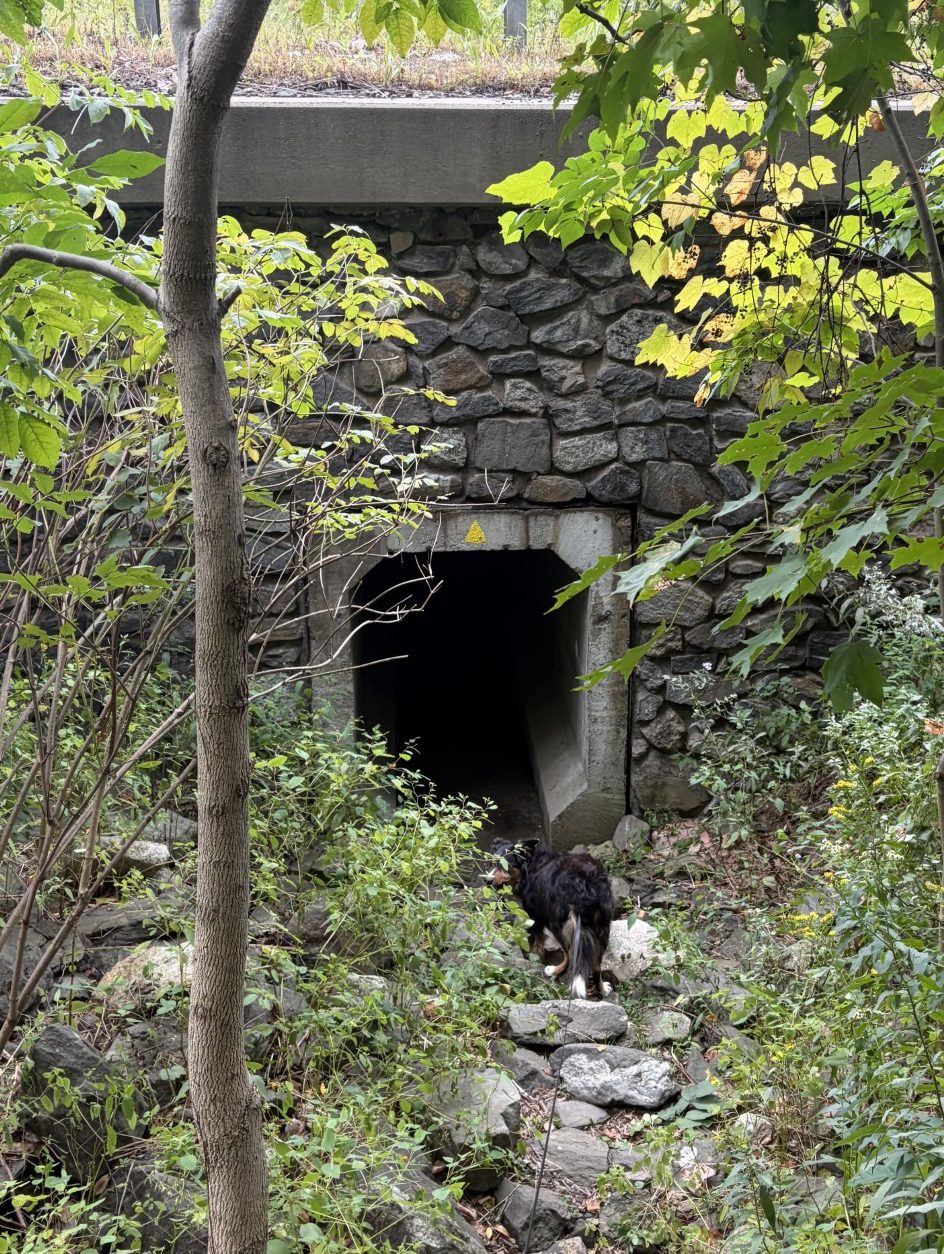
Cow tunnel under Route 20.
Yesterday is history, tomorrow is a mystery, today is God’s gift, that’s why we call it the present.
== Joan Rivers
Today, we start out at a cow tunnel that passes underneath US Highway 20. We’ve come across cow tunnels before. Back in the day, when a railroad, or a highway, passed through a farmer’s fields, these tunnels were put in so cows could pass from one field to another without interfering with traffic (or traffic interfering with the cows). That would have been a very good thing here, because Route 20 is a 4-lane, divided highway, with cars speeding along at around 50 mph. Today, the cows and fields are gone, but the tunnel does provide, for us, a convenient way of getting past the highway. It is narrow and just high enough that I can pass through without stooping.
On the other side, we’re immediately enveloped by forest. There are a few old oaks still growing here. Some look to be 150 to 200 years old, a sight that is all too rare in New England these days. For a while, we follow along on a double-rutted dirt road, wide enough for an SUV. However, there are no tire marks in the soil and it doesn’t look like any motor vehicle has passed this way in a long time. The trail then becomes a footpath passing through new growth forest of oak and birch. About ½ mile into our walk, we take a wrong turn and go off-route. The interactive GPS map on my phone does not follow the yellow blazes on the trees and soon leads us to nowhere. So we backtrack and follow the blazes that take us up to a street. That’s the first time the interactive map has led us astray on this trek and it happens for only a short distance.
We follow the street for a short distance, then turn left and disappear into the forest again, on a footpath. We come out on Northside Rd and walk above the Mass Turnpike, I-90. This is one of the main streets of Northside, Mass, a small community founded around 1735. Today, there are a number of buildings, built prior to 1850, that are still standing. We pass by a small one-room white building with a belfry, Charlton No. 2 Schoolhouse, built in 1838. Where Northside intersects with Stafford Road, we pass a large refurbished wooden building, Rider Tavern, that has a sign out front. It reads that, at that spot, General Lafayette stopped at Wilson’s Coffee House on his tour through the area on Sept. 3, 1824.
Soon, we’re back in the woods, winding our way between small bole tree trunks. In about ½ mile, we come to the cemetery where we turned around on our last walk and we head back toward the car. Although we pass people driving their cars, when we’re on the roads and streets, we pass no one we can converse with. There is no one else on the trail.
Heading back through country we’ve already seen, I have to pay less focused attention on where we’re going and can let my mind wander a bit. I try to pretend (at those times when we are deep on the woods) that we’re out here walking amongst the trees in the 18th century. That’s not really possible, because the local flora would have been so much different then. There likely would have been many more old growth trees and the undergrowth would have been a different mixture of weeds. Some of the trees that once were common, like the American chestnut, are no longer around. But, even so, my imagination can fill in some of the missing details.
The American chestnut was once a dominant canopy hardwood in New England, some reaching 100 feet tall. Then, about 1904, a devastating fungal pathogen was introduced from Asia that decimated billions of native trees by the mid-20th century. The parts of the trees above ground were killed, but the root systems survived. That allows for a few sprouts to rise up in the understory, but they soon get infected and die before they become mature. Alas.
It’s also unlikely there would be a trail to follow out here in the 1700s. “Roads” did exist. Stafford and Northside Roads existed in the 18th-century; stage coaches traveled on them and Northside was a frequent stop for stages travelling east and west. But, of course, those roads would have been a far cry from what they are today and it’s hard to imagine horse-powered conveyances when I’m in the midst of gas-guzzling, carbon-emission-belching, rumbling metallic beasts rushing past us. But, in the woods, I can sort of feel something similar to what it must have been like to pass through this area back in the day, when much of the traveling that was done, was done on foot. And, sometimes, it’s not hard at all to pretend that we’re not following a trail…
Waldo is as happy as a border collie chasing a sheep. I often wonder what he’s thinking. Whatever it is, it probably doesn’t translate into human speech or thought. But he is having a really good time. He’s pulling at the leash, eager to go, sniffing everywhere, truly engaged in the world around us.
Back at the car, I see that we’ve gone 6.67 miles with 722 ft of elevation gain in 3 hrs. and 12 min. We now have just a little over 20 miles more to go to the end of the trail. We’ll take a day off to rest, then we’ll be back at it.
We should be able to finish within the next 2 or 3 weeks.
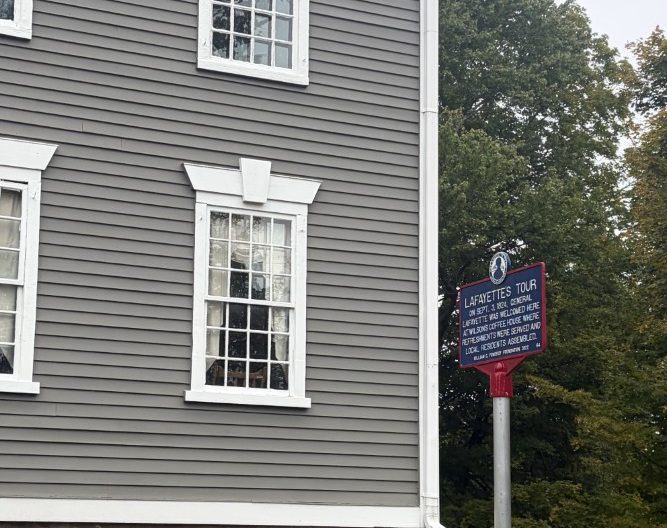
Lafayette passed through here in 1824, 41 years after the end of the revolutionary war.